ECM and PCM Meaning: What These Automotive Acronyms Stand For
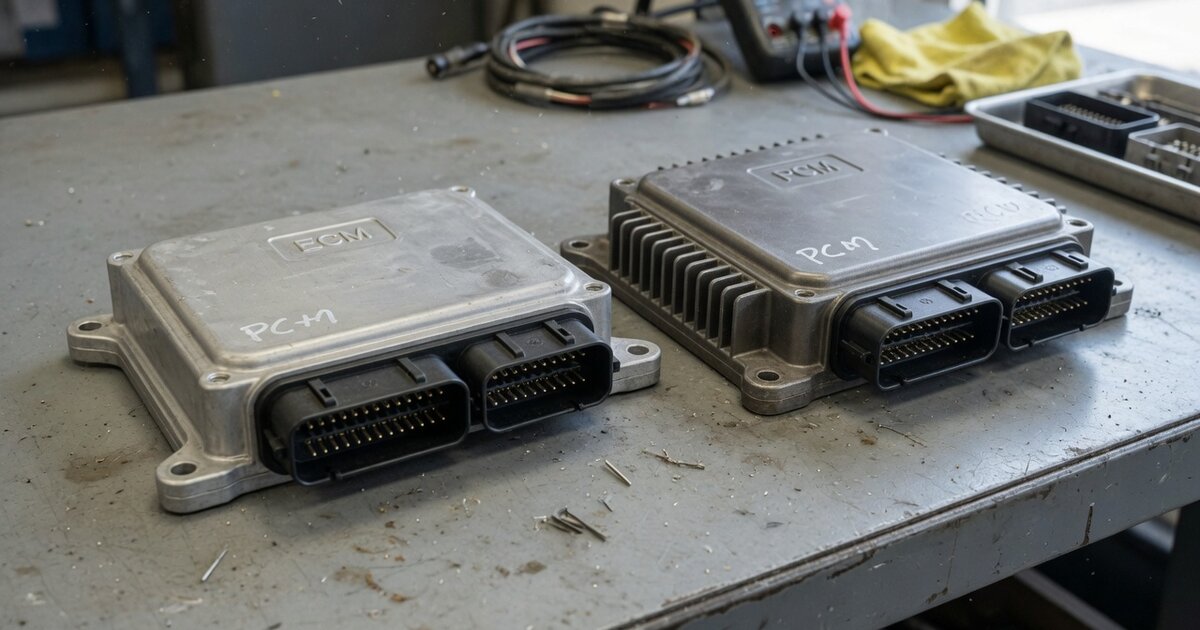
If you've ever popped the hood, called a dealership, or shopped for a diagnostic scan tool, you've likely run into both ECM and PCM in the same sentence — sometimes describing what looks like the same part. That overlap isn't a typo. Both acronyms name real automotive control computers, but they don't always refer to identical hardware, and understanding the words behind the letters clears up a lot of confusion before you ever plug in a scanner. This article breaks down what each letter actually stands for and where the terminology came from, so the next time a parts catalog or a repair manual throws one at you, you'll know exactly what's being described.
What Each Letter Stands For
ECM stands for Engine Control Module. It's the module responsible for managing the engine itself — fuel injection timing, ignition timing, idle speed, and emissions-related functions such as fuel trim. You'll also see the nearly identical term ECU, or Engine Control Unit; the two are used interchangeably in most technical writing and manufacturer documentation, referring to the same physical computer under different naming conventions.
PCM stands for Powertrain Control Module. The word "powertrain" is the key difference: rather than covering only the engine, a powertrain control module is generally built as a combined controller that folds together the functions of the engine control unit and the transmission control unit into a single computer. In practice, that means a PCM manages engine operation and also has a say in how and when the transmission shifts, when a torque converter locks up, and how the two systems coordinate with each other.
Because the PCM sits at the center of so many interconnected systems — sometimes influencing well over a hundred sensor inputs and output commands — it's also the module that raises the check engine light when something drifts out of range. Whether your particular vehicle actually uses a combined PCM, a standalone ECM, or both is a separate question with a real answer that varies by manufacturer; see Is ECM and PCM the Same Thing? A Clear Answer for the full comparison.
Where These Terms Come From
The idea of an electronic "brain" managing an engine is older than the automotive computer itself. The earliest engine control units go back to aircraft engines in the late 1930s, where mechanical-hydraulic units — not the solid-state electronics we think of today — regulated engine performance. One notable early example was the Kommandogerät system built by BMW in 1939 for the BMW 801 radial engine used in military aircraft, an early attempt at automating multiple engine control functions through a single device rather than leaving each adjustment to the pilot.
Automotive engine control computers arrived decades later, once electronics were compact and reliable enough for underhood use. Ford's EEC (Electronic Engine Control) system reached mass production in 1975, and Bosch followed with its Motronic engine management system in 1979. These systems were the direct ancestors of what's now generally called an ECM: dedicated computers whose entire job was managing engine operation electronically instead of through purely mechanical means.
The powertrain control module came slightly later, as manufacturers began linking engine management to transmission behavior. Early PCM implementations date to the late 1970s, with wider, more official adoption in the early 1980s — a period that also brought electronically controlled carburetors and lockup torque converters, both of which needed close coordination with engine timing to work properly. General Motors, for instance, referred to its own 1981 diagnostic-capable engine computer as an Engine Control Module (ECM), a naming choice that stuck with GM vehicles ever since, even on later models where the module actually manages powertrain-level functions in the PCM sense. Because manufacturers settled on different labels for similar hardware, PCM, ECM, and ECU are all still in circulation for what may be, depending on the automaker, essentially the same generic module — which is why it helps to confirm the exact module your own vehicle carries rather than assume from the acronym alone; walk through Does My Car Have a PCM or ECM? Here's How to Check to identify it.
Common Mistakes to Avoid
- Guessing at the wrong expansion. The letters don't stand for "Powertrain Computer Module" or "Electronic Control Module." The standard, correct expansions are Engine Control Module (ECM) and Powertrain Control Module (PCM).
- Assuming ECM and PCM are always two separate physical parts. On many vehicles, particularly GM products, the single module doing PCM-level work is still labeled ECM by the manufacturer, so the name on the part doesn't always match the strict textbook definition of what it does.
- Treating ECU as something different from ECM. In day-to-day automotive repair, they refer to the same engine computer. Broader electronics terminology sometimes uses "ECU" as an umbrella term for any control unit in a vehicle, which can cause confusion if you assume it always means the engine specifically.
- Assuming one brand's terminology applies to every brand. The term used in an owner's manual, parts catalog, or scan tool software depends on that manufacturer's own naming convention from decades ago, not a single industry-wide rule everyone follows the same way.
- Ordering a replacement module or programmer by acronym alone. A listing labeled for "ECM programming" and one labeled for "PCM programming" may describe the very same physical unit on a given vehicle, or they may not. Confirm which module your specific make, model, and year actually uses before buying.
Frequently Asked Questions
Are ECM and ECU the same thing?
In everyday automotive language, yes — both refer to the engine's control computer, and manufacturers use the two terms interchangeably in manuals, part listings, and diagnostic software. In broader electronics engineering, "ECU" is sometimes used as an umbrella term for any control unit in a vehicle, including ones that manage the body, transmission, or brakes. But in routine repair and programming work, treat ECM and ECU as synonyms for the same part.
Does PCM mean the same thing as ECM?
Not exactly, though the two can end up describing the same physical module depending on the vehicle. PCM stands for Powertrain Control Module and, where the term applies strictly, combines engine control and transmission control in one unit. ECM stands for Engine Control Module and traditionally refers to engine management only. Some manufacturers use "ECM" as their label even for a module handling full powertrain-level functions, so the printed name doesn't always match the strict definition — confirm the actual configuration on your vehicle rather than assume from the acronym.
Why do different car brands use different terms for what looks like the same part?
Because each automaker developed its engine and transmission control systems somewhat independently as the technology matured through the 1970s and 1980s, before industry terminology had fully settled, and many brands simply kept their original naming conventions afterward. General Motors, for example, has continued using "ECM" on vehicles where the module functions as a combined powertrain controller, largely because that was the term GM adopted early on and never changed.
When did cars start using engine control computers?
Dedicated electronic engine control in production cars dates to the mid-1970s, with Ford's EEC system entering mass production in 1975 and Bosch's Motronic system following in 1979. Control that also managed the transmission alongside the engine became more common in the early 1980s, alongside the introduction of electronically controlled carburetors and lockup torque converters, both of which needed tighter coordination with engine timing than earlier mechanical systems allowed.
Is TCM a separate term worth knowing?
Yes. TCM stands for Transmission Control Module, sometimes called TCU (Transmission Control Unit), and it's the computer that manages shift points and torque converter lockup when it exists as a standalone unit rather than being folded into a combined PCM. Whether your vehicle has a separate TCM or a single PCM handling both jobs depends on the manufacturer and model year.
Does knowing the correct term matter when buying a scan tool or programmer?
It matters more than most shoppers expect, because product listings, firmware, and compatibility charts are usually written using the manufacturer's own terminology rather than a single universal standard. A tool advertised for "ECM programming" and one advertised for "PCM programming" may support the exact same physical module on a given vehicle, or they may not. Match the tool to what your specific make and model actually calls its control module, rather than to whichever acronym you happen to be more familiar with.