Is ECM and PCM the Same Thing? A Clear Answer
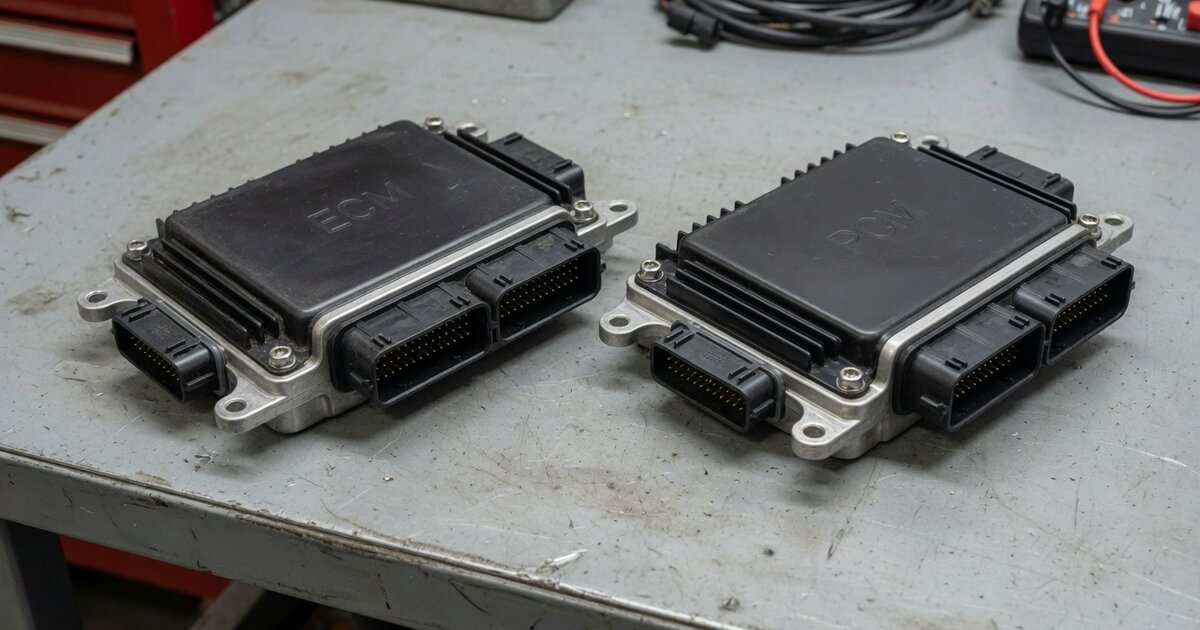
Search for "is ECM and PCM the same thing" and you'll find mechanics giving different answers depending on the vehicle in front of them — which is exactly the problem. Both acronyms refer to a car's onboard computer, both show up on repair estimates and diagnostic printouts, and both get swapped for each other constantly in casual conversation. But they don't always describe the same hardware. Whether ECM and PCM are the same thing in your case depends on what your specific manufacturer actually built into that one metal box under the hood. Here's the direct answer, why the mix-up happens, and how to avoid ordering or diagnosing the wrong part.
The short answer
No, ECM and PCM are not strictly identical, though on many modern vehicles they end up describing the same physical module. An Engine Control Module (ECM) is a dedicated computer that manages engine-specific functions: fuel-air ratio, ignition timing, idle speed, emissions control, and cooling. A Powertrain Control Module (PCM) does everything an ECM does, plus it also manages the transmission — shift points, torque converter lockup, and communication with the transmission's own sensors. In practice, a PCM is usually an ECM and a Transmission Control Module (TCM) combined into a single housing, sharing data so the engine and transmission work together instead of operating as two isolated systems. So if your vehicle uses a genuine standalone ECM with a separate TCM, the two terms describe different hardware. If your vehicle uses a combined unit, calling it either an ECM or a PCM is describing the same box — just emphasizing a different part of its job.
Why the confusion exists
The overlap isn't accidental — it comes from how these systems evolved and how manufacturers chose to label them. Early production vehicles ran engine management and transmission management as two independent computers, each with its own processor and programming. As automakers looked for better coordination between shifting and throttle response, and for cost and wiring savings, many combined the two into one integrated controller and called the result a PCM. That's why the PCM is often described as running engine and transmission control functions inside the same housing, even in cases where the internal circuits for each system are still effectively separate. For a full breakdown of what the engine-side controller does on its own, see this guide to the Engine Control Module (ECM), and for the transmission-inclusive version, see this explainer on the PCM (Powertrain Control Module).
Manufacturer naming adds another layer. GM has long used PCM as its standard term for the main engine-and-transmission computer. Ford tends to keep the two separate, referring to an ECM for engine functions and a distinct TCM for transmission functions rather than merging both under one label. Chrysler and Dodge frequently use PCM even in situations that other brands would simply call an ECM, and the term sticks regardless of the exact internal configuration. Add in generic OBD-II scan tools, which often default to labeling the primary control module "PCM" as a catch-all category no matter what a given manufacturer actually calls the part, and it becomes easy to see why the two terms get used loosely across the industry.
Common mistakes to avoid
A few habits cause real problems once these terms get treated as fully interchangeable:
- Ordering a replacement part by the wrong label. A part number is tied to the exact module and its programming, not to whether you called it an ECM or a PCM on the phone. Ordering "an ECM" for a vehicle that actually runs a combined PCM can get you the wrong unit entirely.
- Assuming a code read from a "PCM" always points to a transmission problem. Many scan tools report "PCM" generically even on vehicles where the engine and transmission are still controlled by two separate modules, so the label alone doesn't confirm which system triggered the code.
- Assuming programming or flashing procedures are identical across ECM-only and PCM setups. A combined PCM typically needs both engine and transmission calibration data written correctly, while a standalone ECM only needs the engine-side data.
- Assuming every make uses the term the same way. What GM calls a PCM, Ford may split into a separate ECM and TCM — always confirm against the actual vehicle and its documentation, not the generic acronym.
Frequently asked questions
Is PCM just another name for ECM?
Not exactly. PCM is a broader term that covers engine control functions plus transmission control in one unit. On vehicles where the transmission has its own separate module, "PCM" doesn't technically apply, and the correct term for the engine-only computer is ECM. On vehicles where the two are combined, PCM and ECM end up naming the same hardware from different angles, which is why the two get swapped so often in everyday conversation and on parts listings.
Does every vehicle have a PCM, or do some still use a separate ECM and TCM?
No — plenty of vehicles, especially older models and certain Ford platforms, still run a standalone ECM alongside a separate TCM rather than one combined unit. Whether your vehicle has a true PCM or a split ECM/TCM setup depends entirely on the manufacturer and model year, so the safest way to confirm is checking the specific module designation for your VIN rather than assuming based on another vehicle you've worked on.
If my scan tool reports "PCM," does that always mean my engine and transmission share one module?
Not necessarily. Generic OBD-II software often labels the primary control module "PCM" as a default category regardless of whether the underlying hardware is a true combined unit or a separate ECM working alongside its own TCM. Treat the scan tool's label as a starting point for diagnosis, not confirmation of your vehicle's exact module configuration.
Can I order an ECM and a PCM part interchangeably for the same repair?
No. Even when a vehicle uses a combined controller, that part is manufactured and programmed as a single specific component tied to that exact engine and transmission combination. Ordering by the wrong acronym, or assuming any "engine computer" will work, risks getting a module that won't communicate correctly with the rest of the vehicle's systems or won't accept the correct programming at all.
Why do some manufacturers call it PCM and others call it ECM for what looks like the same part?
It comes down to manufacturer convention rather than a strict technical rule. GM has generally standardized on PCM for its main engine-and-transmission computer. Ford tends to keep engine and transmission control identified separately. Chrysler and Dodge frequently use PCM even in setups that function similarly to what other brands would call an ECM. None of these conventions are wrong — they simply reflect how each company chose to label its hardware over the years.
Does it matter which term I use when talking to a shop or ordering a part?
It matters less in casual conversation and more once you're ordering hardware or requesting specific diagnostic work. A shop can usually follow along if you say "ECM" when you actually mean the general engine computer, but for parts ordering, programming, or warranty paperwork, it's worth confirming the manufacturer's exact term and part number rather than relying on ECM and PCM as safe substitutes for each other.