Megamos Crypto: The Immobilizer Vulnerability That Went to Court
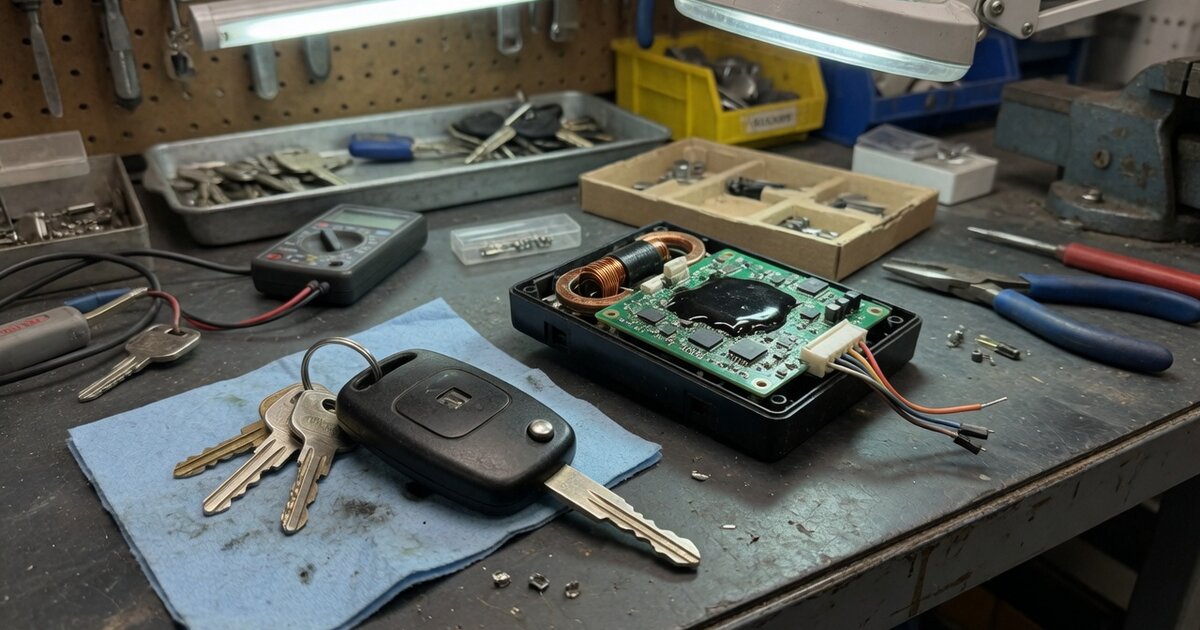
In 2012, a small team of academic security researchers began quietly reverse-engineering one of the most widely used vehicle immobilizer systems in the world. What followed was a three-year saga that included a landmark cryptographic paper, an injunction from a British court, and a rare public standoff between university science and a major automaker. The system at the center of it all was Megamos Crypto — a transponder chip embedded in millions of ignition keys across the Volkswagen Group and beyond.
What the Megamos Crypto research actually found
The research was carried out by Roel Verdult and Baris Ege of Radboud University Nijmegen in the Netherlands, together with Flavio D. Garcia of the University of Birmingham in the UK. Their paper, titled “Dismantling Megamos Crypto: Wirelessly Lockpicking a Vehicle Immobiliser,” set out to reverse-engineer the proprietary cipher and authentication protocol used inside the Megamos Crypto transponder — the chip embedded in a key that “handshakes” with a car's ECU before the engine is allowed to start.
Megamos Crypto was, at the time, one of the most widely deployed transponder systems in the industry, used in the immobilizers of most Audi, Volkswagen, Fiat, Honda and Volvo models, as well as Volkswagen Group luxury marques including Porsche, Bentley and Lamborghini, and some Maserati vehicles. According to the published research, the team identified several weaknesses both in the design of the cipher itself and in how individual carmakers configured and implemented it. Reported issues included the absence of a proper pseudo-random number generator, which left the system exposed to replay-style attacks, and an effective cryptographic strength considerably weaker than the transponder's nominal 96-bit key would suggest. Building on those weaknesses, the researchers described three distinct attacks capable of recovering a transponder's secret key using only wireless communication with the system — no physical disassembly of the key required. In the published results, one attack recovered a key in roughly half an hour; another took about two and a half hours.
It's worth being precise about what this research was and wasn't. It was an academic cryptanalysis of a specific chip's cipher and protocol, conducted under lab conditions with specialized equipment, and disclosed to the chip's manufacturer well in advance of publication. It was not a plug-and-play theft tool, and even the paper's final published form stops well short of a how-to guide. Readers wondering more generally whether modern immobilizers can be defeated at all, and under what circumstances, can find that broader question covered in Can an Immobiliser Be Bypassed?.
The legal fight over publishing it
The researchers did not spring their findings on the industry. Court records show they notified the chip's manufacturer of the vulnerabilities in February 2012, and informed Volkswagen directly in May 2013 — months ahead of the paper's scheduled presentation at the USENIX Security Symposium in Washington, D.C. that August. Volkswagen and Thales, the company behind the Megamos Crypto system, responded not by patching or replying publicly, but by going to court.
In mid-2013, Volkswagen obtained an interim injunction from the High Court of Justice in London — the case is recorded as Volkswagen Aktiengesellschaft v Garcia & Ors [2013] EWHC 1832 (Ch), heard before Mr Justice Birss. Volkswagen argued that publishing the paper's technical detail risked handing a working blueprint to “sophisticated criminal gangs” capable of using it to steal cars. The court sided with Volkswagen on an interim basis, and the researchers were ordered to withhold a key section of the paper. Facing the injunction, the authors withdrew the paper from the 2013 USENIX program rather than publish a compromised version.
The case drew significant attention in academic and tech press as an example of a company using litigation, rather than a technical response, to manage a disclosed vulnerability — and as a cautionary tale for security researchers about the legal risk of publishing findings on commercial products. The dispute eventually ended in an amicable settlement, with no admission of liability by either side. Two years after the original submission, the paper was published — with the previously contested passage removed — in the supplement to the proceedings of the 22nd USENIX Security Symposium in 2015, alongside a related paper on the cryptanalysis of the cipher itself. When contacted by press at the time, an industry trade group representing German automakers downplayed the findings, pointing to falling car-theft statistics and describing manufacturers' existing anti-theft measures as “very effective.”
What it means for owners and technicians today
More than a decade on, the Megamos Crypto case is less a live technical threat than a well-documented data point in the history of automotive immobilizer security — and a case study revisited whenever the balance between disclosure and secrecy in vehicle cybersecurity comes up. Megamos Crypto itself has been superseded in newer vehicles by later transponder generations and cryptographic standards, and the specific weaknesses described in the 2015 paper apply to the systems and vehicle generations covered by that research, not to every immobilizer on the road today.
For technicians, the practical takeaway isn't a shortcut — it's a reminder of how central the transponder-to-ECU handshake is to vehicle security, and how much can go wrong when that data is mishandled during legitimate diagnostic or key-programming work. Whenever a job involves reading, cloning or reprogramming immobilizer data, the safest starting point is the same regardless of which transponder family is involved: confirm you're working from a verified backup before writing anything to the vehicle. The guidance in Why Make a Verified Immobilizer-Data Backup Before Writing Anything walks through why that step matters and how to do it properly.
For owners, the episode is mostly historical interest rather than a reason for alarm about a specific car in a driveway today. Vehicle theft risk is shaped far more by a given model's current-generation security hardware and whether keyless-entry relay attacks are feasible against it than by a chip design studied in an academic lab well over a decade ago.
Frequently asked questions
What exactly is Megamos Crypto?
Megamos Crypto is a transponder chip and accompanying cipher/authentication protocol that was widely used inside vehicle ignition keys to communicate with a car's immobilizer system, confirming the correct key is present before allowing the engine to start.
Which cars used Megamos Crypto transponders?
Published research and reporting on the disclosure list it as used in most Audi, Volkswagen, Fiat, Honda and Volvo models of the era, along with Volkswagen Group luxury brands including Porsche, Bentley and Lamborghini, and some Maserati vehicles.
Did Volkswagen ever fix the vulnerability?
The public record centers on the legal dispute over disclosure and the underlying cryptanalysis rather than a documented patch timeline; the case settled without admission of liability, and the vulnerable chip generation has since been superseded by newer transponder technology in current vehicles.
Why did Volkswagen sue the researchers instead of just fixing the issue?
Volkswagen argued in the UK High Court that publishing the paper's technical detail could hand a workable method to organized car-theft rings, and sought an injunction on those grounds rather than responding with a technical countermeasure before the paper's scheduled 2013 presentation.
Is the original research paper publicly available?
Yes. After the legal dispute was resolved, “Dismantling Megamos Crypto: Wirelessly Lockpicking a Vehicle Immobiliser” was published, with the contested section removed, in the supplement to the proceedings of the 22nd USENIX Security Symposium in 2015, and remains available through USENIX's own archive.
Does this affect immobilizer key programming work today?
Not directly for most current vehicles, since Megamos Crypto has been succeeded by newer transponder systems, but the case is a useful reminder that immobilizer data is sensitive and that any programming job should follow standard safeguards, including working from a verified backup before writing new data to a vehicle's immobilizer or ECU.