PCM (Powertrain Control Module) Explained: Function, Failure Signs, and Replacement
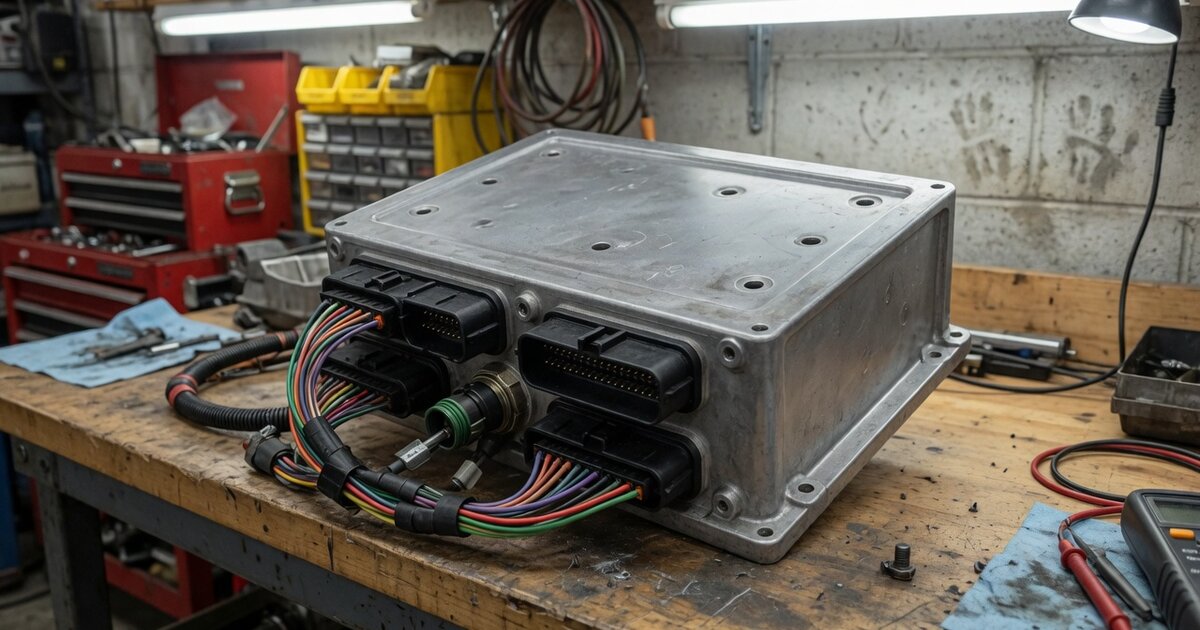
A powertrain control module, or PCM, is the onboard computer that governs how a vehicle's engine and transmission work together. On many vehicles it is the single most important electronic control unit under the hood, constantly reading sensor data and adjusting fuel delivery, ignition timing, and shift behavior in real time. The term is often used loosely, and that causes confusion: some technicians and manufacturers say "ECM" (engine control module) or "ECU" (electronic control unit) when they really mean the same combined unit, while others treat the ECM and TCM (transmission control module) as physically separate boxes that just happen to share data over the vehicle network.
Strictly speaking, a PCM is what you get when engine management and transmission management are combined into one controller, or at least tightly integrated so they act as one from the driver's perspective. Japanese and Korean manufacturers tend to favor the term ECU, General Motors and many domestic brands favor PCM or ECM, and the naming convention can vary even across a single manufacturer's own model lineup. Understanding this module matters because it sits at the center of nearly every driveability complaint a shop sees, from a rough idle to a transmission that won't shift out of second gear, and because replacing or reprogramming it incorrectly can leave a car unable to start at all.
How it works
The PCM constantly gathers input from dozens of sensors: mass airflow or manifold pressure, crankshaft and camshaft position, coolant and intake air temperature, oxygen or air-fuel ratio sensors, throttle position, and vehicle speed. Using that data, it calculates fuel injector pulse width, ignition spark timing, idle air control, and emissions-related functions such as EVAP purge and EGR flow. On the transmission side, when transmission control is folded into the PCM, it also decides shift points, torque converter lockup, and line pressure based on throttle input, engine load, and road speed, which is why a PCM fault can produce both an engine drivability problem and an erratic-shifting transmission at the same time.
Beyond the powertrain itself, the PCM typically communicates over the vehicle's CAN bus with the body control module, instrument cluster, and anti-theft or immobilizer system. On most modern vehicles the engine will not start, or will start and immediately stall, unless the PCM confirms it is talking to a recognized key or transponder through that immobilizer link. That relationship is why swapping a PCM is rarely a simple bolt-in job: the replacement module usually needs to be matched to the vehicle's VIN and synchronized with the existing keys and security system, not just physically installed.
What to consider
A failing PCM can mimic dozens of other problems, which is part of why it gets misdiagnosed so often. Before assuming the module itself is bad, a proper diagnosis should rule out wiring, grounds, and individual sensors, since those failures are far more common and much cheaper to fix than a control module. That said, there are patterns worth watching for, along with practical points to keep in mind if replacement does become necessary.
- An illuminated check engine light, sometimes alongside several other warning lights at once, suggesting a communication or control problem rather than a single sensor fault.
- Rough idle, stalling, or hesitation that doesn't correlate with a specific, easily identified sensor code.
- Hard starting or a no-start condition, often tied to loss of fuel injection or ignition control.
- Noticeably poor fuel economy with no obvious mechanical cause.
- Transmission symptoms such as harsh or delayed shifts, or the transmission getting stuck in a single gear (limp mode).
- Intermittent faults that come and go, which can point to a marginal PCM, a bad ground, or corrosion at a connector rather than a clean failure.
- Most replacement PCMs need to be programmed to the vehicle before they will run correctly, which is a separate step from simply bolting the unit in.
- A used or reused PCM usually carries the old vehicle's VIN and security data, and mismatched VIN or immobilizer data is a common cause of a no-start after a module swap.
- After a PCM replacement, existing keys typically need to be relearned to the new module's immobilizer settings before the vehicle will start reliably.
Common mistakes to avoid
Most of the trouble people run into with a PCM comes from skipping steps rather than from the module itself being defective. A little patience during diagnosis and replacement avoids a second trip back to the shop.
- Replacing the PCM before ruling out simpler causes such as a failed sensor, bad ground, or damaged wiring harness.
- Installing a used PCM without addressing its stored VIN and security data, which can leave the vehicle unable to start.
- Skipping the programming step, assuming a new module will simply work once it's bolted in.
- Forgetting to relearn or resynchronize existing keys with the new module's immobilizer system.
- Not scanning all related modules (BCM, instrument cluster, ABS) for immobilizer-related faults after a swap, since a security mismatch on one module can prevent the whole system from settling.
- Attempting a full module or key programming module replacement guide using Yanhua Mini ACDP or similar without first confirming the tool supports the specific platform and PCM variant involved.
Frequently asked questions
Is a PCM the same thing as an ECU?
Not always, but the terms are often used interchangeably in casual conversation. Strictly, an ECU or ECM manages the engine alone, while a PCM combines engine and transmission control into one unit or one tightly linked system. Which term a given manufacturer uses depends on their own naming convention, so the safest approach is to check the specific vehicle rather than assume based on the label alone.
Can a bad PCM cause a no-start condition?
Yes. Because the PCM controls fuel injection, ignition timing, and often communicates with the immobilizer system, a failure in any of those functions can leave the engine unable to start or cause it to stall immediately after starting. A no-start is also commonly caused by wiring or a dead battery, so a proper diagnostic scan should confirm the PCM is actually at fault before it gets replaced.
Do all replacement PCMs need to be programmed?
Most do. A new or reconditioned PCM generally arrives without the vehicle-specific calibration, VIN data, and security information it needs to run the car, so it has to be programmed or flashed after installation. Skipping this step is one of the most common reasons a freshly installed PCM doesn't bring the vehicle back to normal operation.
Why won't my keys work after a PCM replacement?
When a PCM is replaced, its immobilizer data no longer matches the keys that were previously paired to the vehicle. The keys typically need to be relearned or resynchronized to the new module using an appropriate diagnostic or key programming tool before the vehicle will recognize them and allow starting.
Can a PCM be repaired instead of replaced?
In some cases, yes. Certain PCM faults, such as damaged connector pins, corrosion, or specific internal component failures, can be repaired rather than requiring a full replacement, similar in principle to repairing a control module after a failed programming attempt. Whether repair is practical depends on the failure mode and the technician's access to the right diagnostic and repair equipment.
What's the difference between a PCM and a TCM if my car has both?
On vehicles where the transmission has its own separate controller, the TCM handles shift points, torque converter lockup, and line pressure, while the PCM or ECM focuses on engine management, and the two communicate over the vehicle network. On vehicles marketed as having a PCM, that transmission function is usually already built into the same module, so there is no standalone TCM to worry about.