Why a New Key-Fob Battery Dies in Weeks or Months
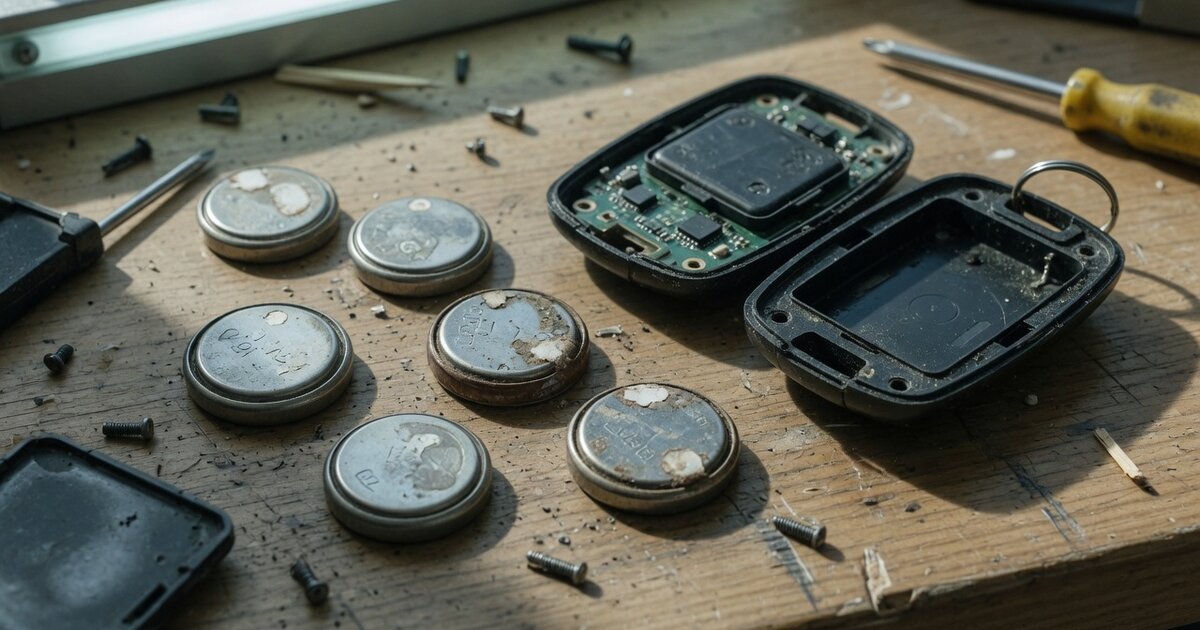
A new key-fob battery that dies in weeks or months usually points to a poor contact, a stuck button, moisture, or an abnormal current draw on the fob board. A healthy coin cell should not be diagnosed from its label alone; measure and compare the symptom.
Why a New Key-Fob Battery Dies in Weeks or Months: identify the system that still works
A key fob is not one single function. A radio remote can send a command, a passive-entry system can wake an exterior antenna, and an immobilizer transponder can authorize starting. Start with an observation sheet: note whether lock, unlock, passive entry, trunk release, warning LED, and engine start work. Record distance in metres and whether the same result occurs with a spare fob. This prevents a visible symptom from being mistaken for continuous drain rather than ordinary cell aging.
Definition: a key fob is a portable device that may contain a radio transmitter, a battery, button switches, and an immobilizer credential. Those components can fail independently. A result from one function is evidence about that function only; it is not a verdict on the whole key.
How to diagnose continuous drain rather than ordinary cell aging step by step
- Use the fob in a familiar open location and write down the result.
- Repeat the same command with a spare fob if one exists.
- Change one condition at a time: location, distance, button, vehicle setting, or battery seating.
- Inspect only after the comparison identifies the likely side of the system.
Keep the test short and repeatable. For example, test unlock at 1 metre, then 5 metres, then 10 metres, with the vehicle in the same state. A result that changes only at one place tells a different story from a result that changes only when one button is pressed. Do not treat a single press as a measurement.
Worked example with numbers
a fob using a CR2032 cell lost function after 6 weeks. Its rubber panic button was held slightly down by a warped shell. With the shell open, the button released and the current draw returned to an intermittent, low standby pattern. The useful numbers are not universal limits; they make the sequence falsifiable. In this example, 38 minutes, 24 hours, 3.0 volts, 1.2 metres, or a 0.5-metre range describes what was observed, not what every model must do. Write your own figures beside each test. If a second fob behaves differently at the same 2-metre position, the comparison is stronger than a guess based on age.
| Observation | What it supports | Next check |
|---|---|---|
| One function works | A partial path remains intact | Test the failed function alone |
| Both fobs fail in one place | Location or vehicle-side influence | Move 20 metres and repeat |
| Only one fob fails | Fob-specific fault is plausible | Inspect battery, shell, and switch path |
Common mistakes that make diagnosis worse
Installing several cells in succession, bending contacts until they tear, storing the fob under a heavy object, and blaming the car before examining the fob. Another frequent error is changing two variables together: inserting a new cell, moving to another place, and opening the shell before retesting. That creates an apparent improvement with no known cause. Photograph the battery orientation before removal, keep small parts in one container, and do not scrape contacts. If a vehicle manual gives an emergency reader location or a passive-entry setting, use that documented information rather than a sequence intended for a different model.
What this symptom does and does not prove
A rapid drain test cannot predict a vehicle receiver failure or authenticate a replacement cell. Some proximity fobs wake more often near the vehicle. The test is most useful when it narrows a decision: continue with a simple observation, inspect a specific physical part, or stop before causing damage. It does not create a vehicle credential, bypass an immobilizer, or establish that a fob belongs to a vehicle. Security-related functions should be handled only with the authorized vehicle and its documented service procedure.
How external evidence fits the check
Volvo Forums records owner reports of unusually fast key-fob battery discharge, useful as a symptom comparison rather than a universal specification. That source is named to show the origin of the general symptom pattern, not to substitute for a manufacturer manual. Vehicle designs differ in radio frequency, antenna placement, battery type, and emergency-start method. Treat model-specific instructions as controlling evidence when they conflict with a general diagnostic example.
For related background, see the site’s battery and key fob pages. A clear note of the working and failed functions will make any later diagnosis more precise.
When to stop testing
Stop and use the vehicle documentation or appropriate technical help if the fob becomes hot, the battery leaks, the board is visibly cracked, a security warning remains on, or the vehicle cannot be secured safely. Avoid repeated start attempts with a warning present. Preserve the original fob and any detached transponder; the original components are useful evidence even when a repair is not appropriate.
Build a reliable comparison before opening the fob
Make a small result grid instead of relying on memory. Put each available key on a separate row and list lock, unlock, passive entry, engine authorization, and the observed distance in metres in separate columns. Repeat a failed command three times with a pause of 10 seconds. Three matching outcomes are more useful than one dramatic failure, because a marginal radio path can vary from press to press. If the symptom follows one fob while the vehicle and location remain unchanged, attention can move toward continuous drain rather than ordinary cell aging. If it follows the vehicle or the location while multiple fobs agree, do not dismantle a working fob merely because it was present when the symptom happened.
Also record the order of events. A failure after a wash, a fall, a vehicle battery change, or a menu change has a useful time relationship, but it is still a clue rather than proof. The event may reveal an existing weak contact instead of creating it. The question to ask is: what observation would contradict my first explanation? A spare-fob test, a different parking location, or a documented emergency-start test often supplies that contradiction safely.
Physical checks with a narrow purpose
Open a fob only when the comparison points to the fob and the shell is designed to be opened. Work on a clean dry surface with the battery removed. Look for a displaced cell, powdery residue, a button that does not return to the same height as its neighbours, a loose glass or ceramic transponder, and a board that flexes when the case closes. These observations are descriptive: “left spring is 1 millimetre away from the cell edge” is better than “contact looks bad.” Reassemble without trapping a button and repeat the same one-metre command test. A changed result after reseating a component is meaningful only if all other conditions stayed the same.
Do not use household liquids on an assembled fob, do not bridge contacts with metal tools, and do not heat a coin cell. A coin cell can leak or short if mishandled. If corrosion is visible, photograph it before cleaning so the symptom has a record. A visible crack through a board or a separated transponder moves the issue beyond a simple battery check. In that situation, preserving the parts and the result log is safer than further experiments.
Decision guide for the next observation
| Pattern after repeat tests | Interpretation | Safe next action |
|---|---|---|
| Same fob fails everywhere; spare works | The fault is likely local to the first fob | Inspect its battery seating and control path |
| All fobs fail at one building only | Environment or vehicle position affects the result | Move at least 20 metres and retest |
| Remote works but starting fails | Radio command and immobilizer path differ | Use the documented emergency-start method |
| Starting works but passive entry fails | Exterior sensing is a separate path | Compare handles and vehicle settings |
The value of this guide is restraint. It helps avoid turning an observed continuous drain rather than ordinary cell aging symptom into an unsupported conclusion. Keep the original battery, shell pieces, and notes together until the cause is confirmed. That preserves a route back if a new symptom appears after reassembly.