Airbag Calibration: What It Actually Means (and What It Doesn't)
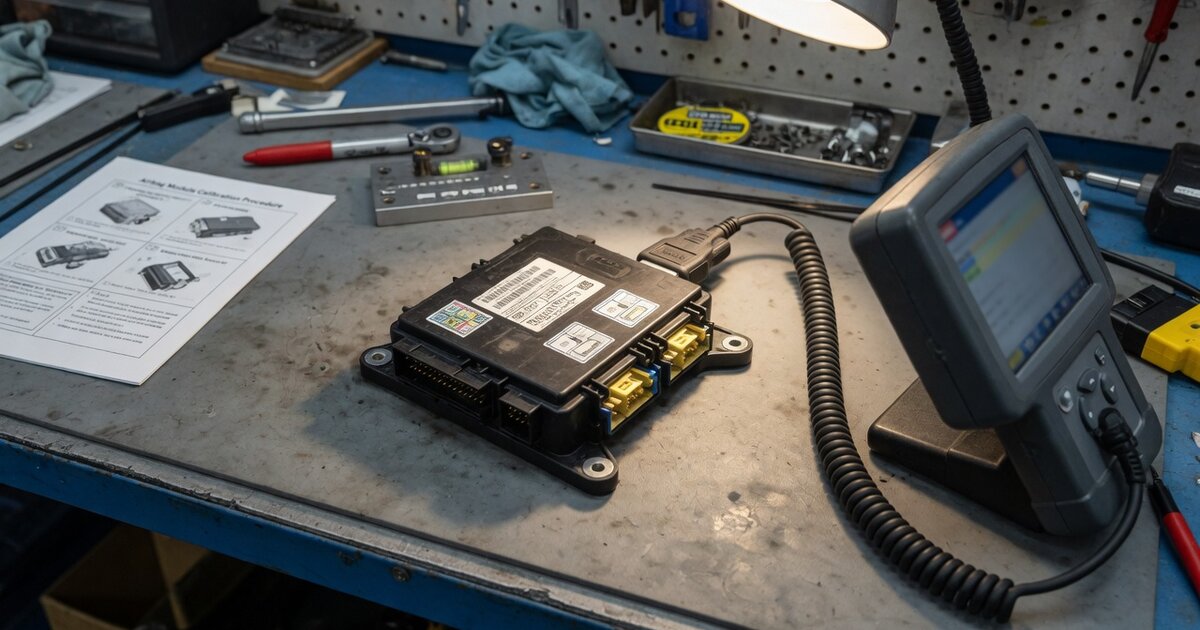
"Airbag calibration" shows up in search bars and on shop invoices more often than it gets a clear definition. It's frequently lumped in with airbag light diagnosis, code clearing, or "resetting" the SRS system generally, but it actually points to something narrower: confirming that the sensors feeding the airbag control module are reporting accurate information, and in many cases, re-teaching the module a fresh baseline reading after those sensors have been disturbed by service work. On a lot of vehicles built over the last two decades, the sensor most often at the center of this is the one that tells the system who or what is sitting in the passenger seat.
This is a general explainer, not a step-by-step procedure to follow at the bench — the exact sequence for verifying or re-teaching a sensor reading differs too much between manufacturers for a generic walkthrough to be safe. What it can do is lay out what the term actually covers, when it comes up in real shop work, and how it differs from three related services already covered on this site: an airbag reset, a lockout tool, and a crash data reset tool. Those three get confused with calibration constantly, and mixing them up in an estimate is an easy way to promise the wrong fix.
What airbag calibration actually means
Many vehicles use an occupant classification system, most commonly built around a set of sensors integrated into the passenger seat cushion, to estimate whether that seat is empty, holds a child seat, or holds an adult occupant. The airbag control module uses that reading, along with input from crash and impact sensors, to decide whether the passenger airbag is allowed to fire at all, and on systems with multi-stage inflators, it can influence how forcefully the bag deploys. Modern SRS control units are built to weigh several inputs together — occupant size and weight, seating position, and seatbelt status among them — rather than treating a passenger seat as a simple on/off switch.
Calibration is the process of confirming that a given sensor's output actually matches physical reality, and where the manufacturer's procedure allows it, re-teaching the control module a new reference point after the sensor, seat frame, seat wiring, or seat cover has been serviced. It's not one uniform procedure applied across every SRS component. Crash and impact sensors, for instance, generally carry no software calibration step at all; their accuracy depends entirely on being reinstalled in the exact mounting location and orientation the manufacturer specified, which is why replacement procedures for those parts are strict about placement rather than about running a relearn routine.
That distinction is also what separates calibration from the other airbag-related services this site covers. An airbag reset service clears fault codes the module has logged because of a wiring problem, a failed sensor, or a buckle switch — it addresses the fault, not the underlying sensor's baseline reading. An airbag lockout tool is a different animal entirely: a temporary bench aid that stands in for a disconnected component so the module doesn't set a fault while a seat or panel is out of the vehicle, and it never touches sensor calibration data. And an airbag crash data reset tool overwrites the module's locked deployment-history memory after a real crash event — a completely separate write operation from adjusting how a live sensor is read going forward. Calibration is the only one of the four that's actually about the accuracy of a sensor's ongoing readings.
When it's needed
Calibration or sensor verification tends to come up around specific kinds of service work rather than as a routine maintenance item:
- Replacing or reinstalling the passenger seat cushion, seat cover, or seat frame, since that's typically where occupant classification sensors are mounted.
- Repairing wiring or connectors in the seat harness circuit that feeds the classification sensor or its control module.
- Replacing an occupant classification sensor or module outright, as opposed to a seat that was simply removed and reinstalled intact.
- Installing a seat, seat cover, or seat-mounted component that didn't originate with that specific vehicle, since aftermarket or salvage parts can shift sensor readings even when everything reconnects electrically.
A practical symptom worth flagging after any of that work is a mismatch between the passenger airbag on/off indicator and the actual occupant — the indicator showing the airbag disabled with an adult in the seat, for example. That mismatch signals the classification reading isn't matching reality, though the fix depends entirely on what the manufacturer's diagnostic procedure finds. Not every piece of SRS-adjacent work triggers a calibration requirement; a seat unbolted and reinstalled in its original position without disturbing wiring or sensors often doesn't need one. The manufacturer's procedure for the specific job performed is what determines whether calibration applies, not a general rule of thumb.
Common mistakes to avoid
- Treating calibration as interchangeable with a reset. Clearing a fault code doesn't verify or re-teach a sensor's baseline reading, and a clean scan after a reset says nothing about whether the occupant classification sensor is reporting accurate data.
- Assuming no warning light means no problem. An SRS light being off confirms no fault is currently logged — it doesn't confirm that a classification sensor disturbed during seat work is still reading correctly.
- Improvising a procedure instead of pulling the manufacturer's documented steps. Because the required sequence, conditions, and tooling vary this much between makes, guessing at a generic process on a system that governs live deployment decisions isn't a shortcut worth taking.
- Leaving a lockout simulator connected as a workaround. A simulator is meant to bridge a circuit temporarily during bench work, not to mask an unresolved sensor or wiring problem that actually needs diagnosis.
- Assuming every seat swap needs the same treatment. A seat moved between vehicles of the same make and model, or paired with non-OEM upholstery, can behave very differently from a same-vehicle reinstallation, and shouldn't be assumed safe without checking the applicable procedure.
Frequently asked questions
Is airbag calibration the same thing as an airbag reset?
No. A reset clears fault codes the SRS module has already logged, typically caused by a wiring issue, a failed sensor, or a buckle switch problem. Calibration is about confirming or re-teaching what a sensor — most often the passenger seat's occupant classification sensor — actually reads. A vehicle can pass a reset with no stored codes and still have a classification sensor that isn't calibrated correctly for the current seat setup.
What sensor does "airbag calibration" usually refer to?
Most commonly it refers to the occupant classification sensor built into the passenger seat, since that's the component whose reading directly changes whether and how the passenger airbag deploys. The term sometimes gets used more loosely for verifying other SRS sensors after service, but crash and impact sensors typically don't have a software calibration step — their accuracy depends on being remounted in the exact original position.
Does every seat repair require a calibration step?
Not automatically. Whether it's required depends on the manufacturer's documented procedure for the specific repair performed. A seat removed and reinstalled intact in its original vehicle may not need it, while replacing the sensor, the seat cushion, or wiring in that circuit more often does. There's no single rule that covers every make and model.
What actually happens if the occupant classification sensor is out of calibration?
The system can misjudge whether the passenger seat holds an adult, a child seat, or nothing at all, which affects whether the passenger airbag is enabled and, on some systems, how it deploys. Since that decision is made in the fraction of a second before a crash, an inaccurate reading is a genuine safety issue rather than a cosmetic dashboard problem.
Can airbag calibration be done without a scan tool?
Manufacturer procedures generally involve a scan tool at some point, often alongside specific seat or occupant conditions. Because requirements vary by manufacturer, the safest approach is following the documented procedure for that vehicle rather than assuming a generic method will work.
Who should be doing airbag calibration work?
A technician following the OEM procedure for that vehicle, with the tooling it calls for. Because the classification reading directly affects how the SRS system responds to a real passenger, this isn't a task to approximate or skip based on how the seat looks or whether a warning light happens to be off.