Airbag Reset Service: What It Actually Does and When You Need One
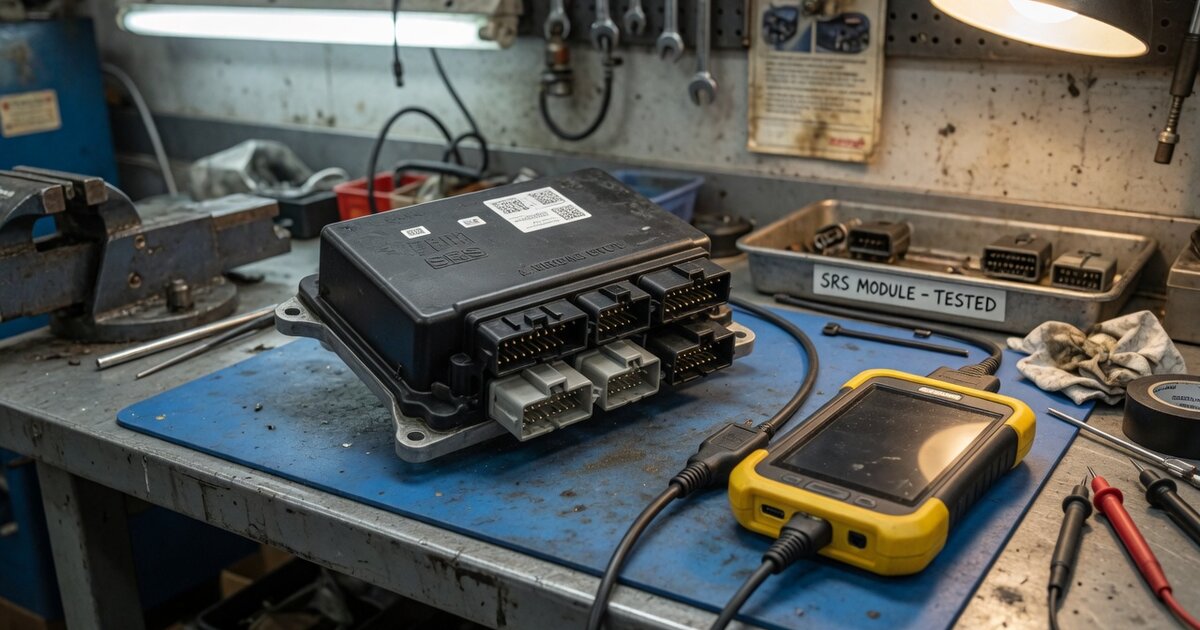
Search for "airbag reset service" and you'll land on two very different kinds of businesses. One is a shop or mobile technician who plugs a scan tool into your OBD-II port, reads a stored SRS fault code, fixes whatever triggered it, and clears the code so the airbag warning light goes out. The other is a specialized module-repair service that reprograms an airbag control unit to erase "crash data" — a locked event record the module writes to protected memory after it detects an impact. These are not interchangeable, and mixing them up is where people get into trouble. This article covers what an SRS reset actually involves, when it's a reasonable step, and when it isn't — because a car's restraint system is safety equipment, and treating a reset as a cosmetic fix for a dashboard light is the wrong way to think about it.
What an airbag/SRS reset actually does
The supplemental restraint system (SRS) is the network of airbags, seatbelt pretensioners, impact sensors, the seatbelt buckle switch, and — on many vehicles — an occupant classification sensor in the passenger seat, all managed by a dedicated airbag control module. That module constantly self-checks the circuits and sensors in the system. When it sees something out of range — an open circuit, a bad resistance reading, a sensor that isn't reporting, a buckle switch that isn't behaving — it stores a diagnostic trouble code (DTC) and lights the SRS/airbag warning lamp on the dash.
In the ordinary case, "resetting" the airbag light is a standard diagnostic task: a technician retrieves the stored code with a capable diagnostic scan tool, traces it to a real cause — a corroded connector under a seat, a damaged wire in a buckle harness, a failed occupant sensor, low system voltage — repairs or replaces that part, then clears the code and confirms the light stays off after a drive cycle. It's the same category of work as clearing an ABS or check-engine code once the underlying fault is fixed, just aimed at the restraint system instead of the engine or brakes.
The second scenario is different in kind, not just degree. When the module detects a collision severe enough to trigger — or come close to triggering — deployment, it permanently records a crash event snapshot to non-volatile memory and, on many designs, locks itself in a disabled state. Ordinary code-clearing generally can't touch that locked crash record; restoring a working, pre-crash state requires reading and rewriting data at the memory-chip level, which is why standalone "airbag module reset" services exist as a distinct trade from routine SRS diagnosis. It is far more invasive than clearing a fault code, and it only ever addresses the module's electronic memory — it does nothing for airbags, pretensioners, or sensors that were physically consumed or damaged in the same event.
When a reset is appropriate vs when it isn't
A straightforward SRS light with no history of a real collision is the case where a reset is reasonable. Typical culprits — a coin or debris jammed in the seatbelt buckle, a corroded under-seat connector, an occupant classification sensor giving an implausible weight reading, a battery that dipped low enough to confuse the module — don't involve any deployed pyrotechnic device. Diagnose the actual fault, repair it, clear the stored code, and the system returns to normal operation. This is routine, low-risk work, handled with the same kind of tooling used for other control-module diagnostics — a general-purpose unit like the one covered in our rundown of the Launch CRP919E's SRS and ABS functions is a fair example of what that looks like on the shop floor.
The picture changes completely once an airbag, seatbelt pretensioner, or knee bolster has actually fired. Airbag inflators and pretensioners are single-use pyrotechnic devices — the chemical reaction that inflates a bag, or the charge that snaps a pretensioner tight, happens exactly once and cannot be reversed or reused. No reset of the control module changes that physical fact. Any component that deployed has to be physically replaced, full stop; a reset only ever concerns the module's stored data, never the hardware that fired.
Even setting the fired components aside, treating a post-deployment module reset as a substitute for proper repair carries real risk. Sources in this space are consistent: a module should not go back into service — reset or not — until every deployed airbag, pretensioner, and associated sensor has actually been replaced; skipping that step is described as both unsafe and, in several accounts, legally problematic under federal motor vehicle safety obligations. It's also worth knowing not every module is designed to be reusable — some manufacturers build units meant to be replaced outright after a qualifying event rather than reset, so the answer differs car to car, not a universal yes.
The practical takeaway: a reset is reasonable for a warning light caused by a sensor, wiring, or switch fault with no deployment history. It's not a shortcut around replacing airbags, pretensioners, or sensors that actually fired, and it should never be presented as making a post-deployment vehicle "as good as new" on its own.
Common mistakes to avoid
The most consequential mistake is assuming any SRS light can be cleared the same way regardless of its cause. Clearing a code without diagnosing the underlying fault just delays the light coming back — and if the issue is a wiring fault rather than a nuisance code, it can leave a genuine gap in restraint-system readiness in the meantime. A related mistake is skipping a full DTC read before doing anything: pulling codes and freeze-frame data first, the way a proper diagnostic tool workflow does, is what tells you whether you're looking at a buckle switch fault or an actual recorded impact — guessing skips the one step that matters.
Buying a module off a salvage vehicle and assuming it will "just work" once installed is another frequent error — a used module may itself carry locked crash data from the donor vehicle, or may not be VIN/calibration-matched to the car it's going into, and skipping that check can leave the warning light on or the system non-functional. And on the shop side, presenting a memory-level reset as routine maintenance, without being upfront that it addresses stored data only and not physical damage, sets an unrealistic expectation for anyone who's actually had a collision.
Frequently asked questions
Can I reset the airbag light myself with a basic OBD2 scanner?
For a stored code with no deployment involved, many entry-level scan tools with ABS/SRS functions can read and clear it. But clearing the code without fixing what caused it — a bad connector, a buckle switch, a sensor — just means the light comes back, sometimes sooner than you'd expect.
How do I know if my airbag module has recorded a real crash event?
A capable scan tool reading the SRS module will show whether it holds a "crash data"/deployment record rather than an ordinary fault code — a shop or technician should be able to tell you which one you're looking at rather than just clearing whatever comes up.
Is it legal to reset an airbag module and put it back in the car?
Clearing a routine fault code isn't a legal issue. Resetting a module that recorded an actual deployment, and reusing it before deployed airbags, pretensioners, and sensors have been physically replaced, is described across the industry as unsafe and, in several accounts, in conflict with federal motor vehicle safety obligations.
Will a module reset fix a deployed airbag?
No. A reset only changes what's stored in the module's memory. An airbag, pretensioner, or knee bolster that has fired is a spent pyrotechnic device and must be physically replaced regardless of anything done to the module's memory.
Why does my airbag light stay on after I fixed the seatbelt?
Some modules need the stored code actively cleared with a scan tool after the repair — the light doesn't always turn off on its own. If it stays on after a proper clear-and-verify cycle, that usually means the original fault wasn't fully resolved or a second fault is present.
Can any repair shop perform an airbag module reset, or does it need to be a specialist?
Ordinary fault-code diagnosis and clearing is within reach of most shops with capable equipment. Clearing locked crash data at the memory level is a narrower specialty — not every tool or shop is set up for it, which is why dedicated module-reset services exist as a separate trade from general SRS diagnostics.