Key Cutting Machines: Types and How to Choose One
Search for "key cutting machine" and you'll mostly find two kinds of results: reviews of one specific model, and guides on where to buy one. What's missing is the step that comes first — understanding that "key cutting machine" isn't one product, it's a category with several genuinely different technologies inside it, built for different keys and different jobs. A machine that duplicates a basic house key by tracing an original won't touch a laser-cut automotive key, and a code-based automotive cutter is overkill for a hardware-store key counter. This overview breaks down the main categories of key cutting machines, what each is actually built to do, and how to think through choosing between them before narrowing down to a specific model.
The main types of key cutting machines
Manual (mechanical) tracer machines
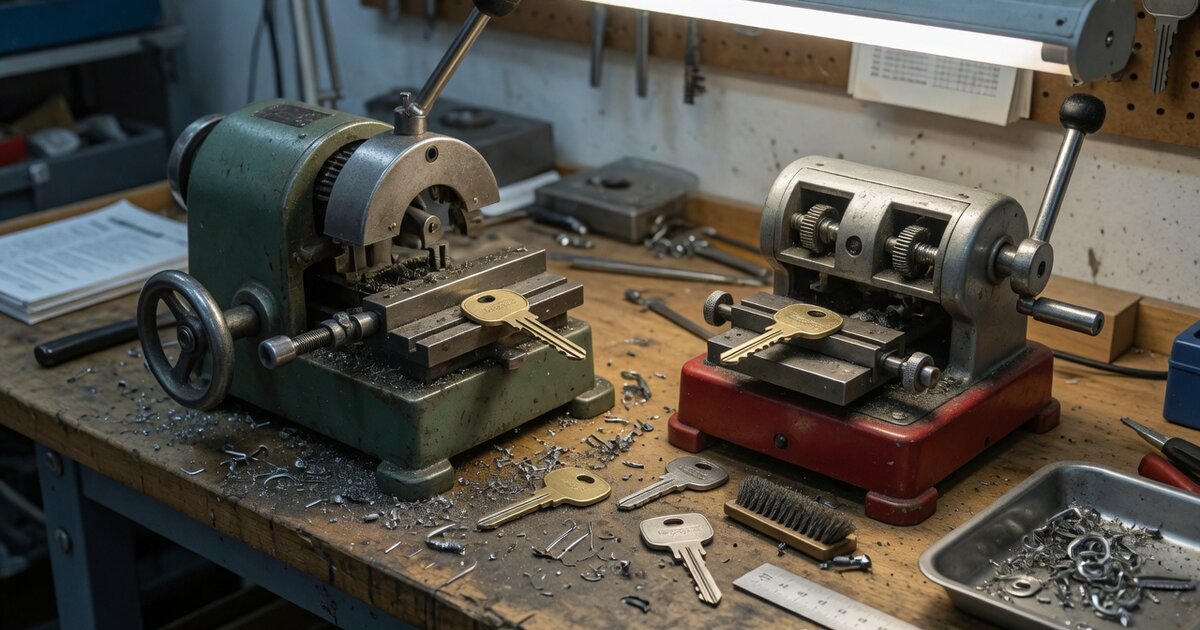
The oldest and still most common design works on a simple principle: a tracer arm (sometimes called a stylus or feeler) follows the grooves of an original key while a rotating cutter, mechanically linked to that arm, reproduces the same cuts into a blank clamped alongside it. The operator handles positioning, clamping, and final calibration by hand — hence "manual" or "mechanical." These machines are built around standard edge-cut keys: the flat, notched keys used for houses, padlocks, mailboxes, and many older vehicles. Accuracy depends heavily on the condition of the original key and the operator's skill. For straightforward duplication work, a well-maintained tracer machine is durable, cheap to run, and needs no software or database to keep working.
Electronic and automatic code-cutting machines
Electronic machines replace the physical tracer with a motor, sensors, and control software. Instead of copying an existing key by feel, the operator enters a key code, selects the key type from a database, or has the machine read bitting information, and the software drives the cutter to the exact depths on its own. This matters most in automotive work, where a customer may show up with no working key at all — an electronic cutter can produce a correctly cut blank straight from a code or decoded lock, something a tracer machine can't do because there's nothing physical to trace. The tradeoff: automatic machines are more complex, cost more, and rely on the manufacturer keeping the key-data database current as new vehicle models appear.
Laser and high-security key cutters
"Laser" here is a naming convention, not a description of how the metal is cut — these machines use precision side-milling or vertical-milling technology, not a literal laser beam, to reproduce the internal grooves and track patterns found on high-security and many modern automotive keys. Standard edge-cut keys have notches on the outer edge; laser-cut (sometimes called sidewinder or track-cut) keys have a groove milled into the flat of the blade, which needs a different cutting geometry and tighter tolerances than a basic tracer setup provides. A machine built for laser-cut keys is generally the wrong tool for high-volume basic duplication and vice versa, which is why many shops run more than one type side by side.
Dual-tracer and dual-sided machines
Some keys — many European laser keys and several high-security profiles — are cut on both sides of the blade rather than one. A single-tracer machine can still handle these, but only by clamping, cutting one side, then unclamping and re-registering the key to cut the other, which introduces room for misalignment. Dual-tracer machines use two coordinated tracer-and-cutter assemblies so both faces are cut in reference to the same fixed position, without repositioning between passes. For a shop that regularly handles double-sided profiles, this isn't a luxury feature — it's the difference between a key that fits first time and one that needs rework.
CNC-style automotive key machines
At the higher end of the automotive segment sit CNC-driven machines that combine code-based cutting, decoding, and an extensive vehicle-model database into one connected unit — the Xhorse Condor/Dolphin line is the best-known example. These pair with a phone app or separate key-programming tool, pull key-blade parameters from an online database covering many makes and models, and cut by biting or code rather than by tracing, with the manufacturer pushing database updates as new models appear. Our breakdown of the Xhorse Dolphin XP-005L key cutting machine covers how one specific model in this category works day to day. Machines in this class are built for automotive locksmiths and dealerships, not general hardware-store duplication.
How to choose between them
Start with the keys you actually cut most often, not the ones you might someday need. A residential locksmith or hardware counter doing high-volume basic duplication is usually best served by a solid manual or entry-level electronic machine for edge-cut keys — a full automotive CNC system there adds cost without adding useful capability. An automotive locksmith needs at minimum an electronic or code-based machine, and increasingly a laser-capable one, since a growing share of vehicles use laser-cut or double-sided keys a basic tracer can't reproduce.
Database coverage and update frequency matter as much as the hardware for code-based automotive cutting — a machine is only as useful as the models it currently supports. It's also worth being realistic about duplicate risk: a single-sided machine can cut a double-sided key across two clamping passes, but the error rate climbs, so if double-sided profiles are routine, a dual-tracer machine earns its extra cost quickly. Anyone building a mobile or shop toolkit from scratch should read our rundown of locksmith tools for beginners building a starter automotive kit before locking in a single purchase, since the cutting machine is only one piece of the setup. Once the category is settled, sourcing a specific unit is a separate question — our guide to where to find a key making machine covers that ground.
Common mistakes to avoid
The most common mistake is buying one machine expecting it to cover every job. Edge-cut, laser-cut, and code-based automotive work differ enough in mechanism that most shops end up with more than one machine, and a single "universal" purchase often means overpaying for a machine that's still a compromise on the highest-volume work. A second mistake is ignoring database subscription costs on electronic and CNC machines — hardware price is only part of the real cost when ongoing updates are required to keep cutting current models. Third, skipping calibration and tracer maintenance on mechanical machines lets accuracy degrade gradually, so keys start coming out slightly off before anyone notices the machine is the cause. Finally, choosing on marketing claims of "handling everything" without checking which specific key types and vehicle makes a machine actually supports tends to produce buyer's remorse.
Frequently asked questions
What's the difference between a key cutting machine and a key duplicating machine?
In practice the terms are used interchangeably. "Duplicating" usually implies copying an existing key, the classic tracer job, while "cutting" is the broader term that also covers code-based and decode-based work with no original key to copy — but both describe the same category of equipment.
Do laser key cutting machines use an actual laser to cut the key?
No. "Laser key" refers to the style of key — one with an internal milled groove rather than edge notches — not the cutting method. The machines that cut these keys use precision milling cutters, not a laser beam.
Can one machine cut both regular house keys and automotive keys?
Some higher-end electronic machines are marketed as handling both, but specialization tends to produce better results and fewer recuts. Most professional shops run a basic edge-cut machine for everyday duplication alongside a separate electronic or laser-capable machine for automotive and high-security work.
Is a manual tracer machine still worth buying today?
Yes, for shops whose volume is mostly standard edge-cut keys. No database to maintain, no software to update, and a long service life keep running costs low even as automotive work shifts toward electronic and code-based cutting.
Why do some automotive keys need a dual-sided or dual-tracer machine specifically?
Certain profiles, including many European laser keys, are cut on both faces of the blade. Cutting both sides in one fixed setup avoids the misalignment risk that comes from clamping and re-clamping between two separate single-sided passes.
How important is database coverage when choosing an electronic or CNC-style machine?
Very important. A code-based or CNC machine that pulls key data from a database is only useful for the vehicles that database currently supports, so update frequency and make/model coverage should weigh as heavily in the purchase as the cutting hardware itself.