Portable Key Cutters: How Handheld Key Cutting Tools Work
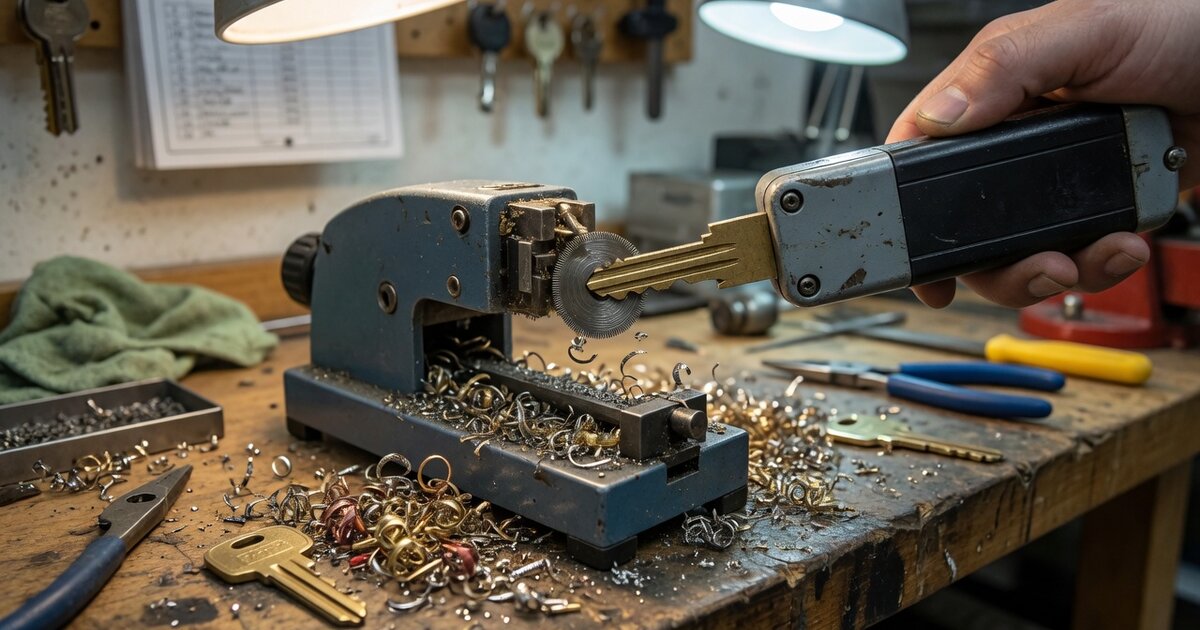
"Key cutters" in this sense means handheld or portable devices used to duplicate keys away from a full-size bench machine — pocket tubular cutters, small manual duplicators, and compact clamp-and-tracer tools that shape a blank by copying an existing key. They differ from the larger automatic and semi-automatic key machines that most locksmiths and dealers keep in a shop, which use motorized cutting wheels or milling heads and can often cut by code or store profiles for many vehicle models at once.
Portable key cutters occupy a narrower niche: field locksmiths making an emergency duplicate at a customer's car, hardware counters that only need to copy simple blanks, and specialty tools built for one key format — most notably pocket tubular cutters used on bike locks, vending machines, and similar cylindrical-pin hardware. They are rarely used for late-model transponder or laser-cut automotive keys, which need the tighter tolerances of a stationary machine plus separate electronic programming of the chip.
Choosing between a handheld cutter and a full key machine mostly comes down to volume, key type, and mobility. A locksmith who mainly handles mobile lockouts might carry a compact cutter for straightforward duplicates while still relying on a shop machine for anything laser-cut, high-security, or requiring code-based cutting.
How it works
Most portable cutters are built around one of a few blank families. Traditional edge-cut blanks — the flat, single-sided keys still used on many vehicle doors, trunks, and older ignitions — have angled cuts ground along one or both edges to match the pins inside a pin-tumbler lock. Laser-cut (also called sidewinder or high-security) blanks are milled through the center of the blade, with a deep groove and mirrored cuts on both faces; that geometry is what gives modern ignition keys their added strength, but it also demands tighter tolerances than a basic handheld tool is designed to hold. Tubular blanks are a separate category entirely: instead of a flat blade, the key is a small cylinder with pins arranged in a circle.
A manual handheld cutter works mechanically rather than electronically. The device clamps the original key and a blank side by side (or, for tubular cutters, seats the blank in a rotating collet), and a guide or tracer follows the original's pattern while a cutting wheel or blade reproduces it onto the blank. Pocket-sized tubular cutters typically include a built-in depth gauge so the operator can set cut depth and pin position before turning the cutting mechanism, rather than relying on a motor to calculate depths automatically. Blanks themselves are usually nickel silver or brass — soft enough to cut cleanly with hand pressure but durable enough to hold their shape in daily use.
Because these tools cut by tracing an existing key rather than by entering a manufacturer code, they can only duplicate a key that already exists and works; they can't originate a key from a code the way a code-cutting bench machine can.
What to consider
A handheld or pocket key cutter is a supplement to, not a replacement for, a full key machine in most professional settings. Before relying on one — for field locksmith work, a hardware counter, or DIY use — it helps to weigh a few practical points.
- Which blank families the tool actually supports — most portable cutters handle only edge-cut or only tubular blanks, not both, and none realistically handle laser-cut or high-security automotive keys.
- Whether the job needs a duplicate from an existing key or a key made from a code, since handheld tracer-style cutters only do the former.
- The condition of the original key being traced, since a worn or previously mis-cut original will pass its errors on to every duplicate.
- Blank material and quality, since a poorly made blank can bind in the clamp or wear the cutting wheel prematurely.
- Whether the target lock or ignition is transponder-equipped — cutting the blade is only half the job, and the chip still needs separate key fob programming.
- How the depth gauge is calibrated and how often it needs checking, since a drifted gauge produces keys that look right but don't turn smoothly.
- Portability versus precision — smaller, lighter tools are easier to carry but generally offer less fine control than a bench machine's motorized cutting head.
- Availability of replacement cutting wheels, since a handheld cutter with a dull or damaged wheel can't be serviced as easily as swapping a cutter on a full machine.
- Whether a full duplicate is even needed — for a lost fob rather than a damaged blade, a key fob replacement may be the more direct route.
Common mistakes to avoid
Because handheld cutters are mechanically simple, it's easy to assume they're foolproof — but small errors compound quickly when a motor isn't handling the calibration for you.
- Trying to cut a laser-cut or sidewinder automotive key on a tool built only for edge-cut blanks, which produces a key that won't seat correctly even if it looks close.
- Skipping the depth gauge check and eyeballing cut depth, a common source of keys that turn stiffly or skip a pin.
- Tracing from a worn or already-duplicated original instead of the best available key, which copies accumulated errors onto every new blank.
- Assuming a correctly cut blade means the key will start the car, when a transponder chip still needs to be programmed separately.
- Using low-quality or mismatched blanks that don't match the original's blade profile, causing binding in the clamp or an unreliable cut.
- Neglecting routine maintenance of the cutting wheel, letting it dull to the point where it drags instead of cutting cleanly.
Frequently asked questions
What's the difference between a portable key cutter and a full key machine?
A portable or handheld key cutter is a compact, usually manual tool that traces an existing key onto a blank using hand-operated clamps and a cutting wheel. A full key machine is a bench-mounted, often motorized device that can cut by code, handle laser-cut and high-security profiles, and store cutting data for many vehicle models. Portable cutters trade that range and automation for size and mobility, which is why professionals still keep a full machine in the shop even while carrying a compact cutter in the field.
Can a handheld key cutter make a working transponder car key?
Cutting the metal blade is only part of making a transponder key work — the chip inside the head also has to be programmed to the vehicle's immobilizer system separately. A handheld cutter that traces a correctly shaped blade can produce a blank that fits the lock, but it has no role in the electronic pairing step. That programming is typically done with dedicated diagnostic or key programming equipment, not with the cutting tool itself.
What kinds of key blanks work with a portable cutter?
Most handheld cutters are built for one blank family at a time. Simple edge-cut blanks, still common on doors, trunks, and some older ignitions, are the most widely supported. Pocket tubular cutters handle the cylindrical blanks used on bike locks, vending machines, and similar hardware. Laser-cut and high-security automotive blanks, with their center-milled, mirrored geometry, generally require a stationary machine built to hold tighter tolerances than a hand tool can manage.
Are pocket-sized tubular key cutters legal to own?
Rules vary by location, and this isn't legal advice, but in many places owning a key cutting tool isn't restricted the way lock-picking tools sometimes are, since cutting a key is a normal locksmith and hardware-store function. Some jurisdictions do regulate possession of tools capable of bypassing locks without authorization, so anyone unsure should check local law before buying or carrying one, particularly for professional or mobile locksmith use.
How accurate is a handheld key cutter compared with a bench machine?
Accuracy depends heavily on the operator, the condition of the original key, and how well the depth gauge is calibrated, since there's no motor recalculating positions automatically. A well-maintained handheld cutter can produce a clean working duplicate of a simple edge-cut key, but bench machines generally hold tighter, more repeatable tolerances, which matters more for laser-cut or high-security keys than for basic household or older vehicle keys.
Do I need a key cutter if I just need a replacement car key fob?
Not necessarily. If the goal is a working spare fob rather than a duplicate metal blade, the more direct path is usually key fob replacement — sourcing a compatible fob and having it programmed to the vehicle. A key cutter matters mainly when the mechanical blade, the part that still turns a manual door or ignition lock, also needs to be duplicated or replaced.