What Is a Keyless Transmitter and How Does It Work in a Key Fob?
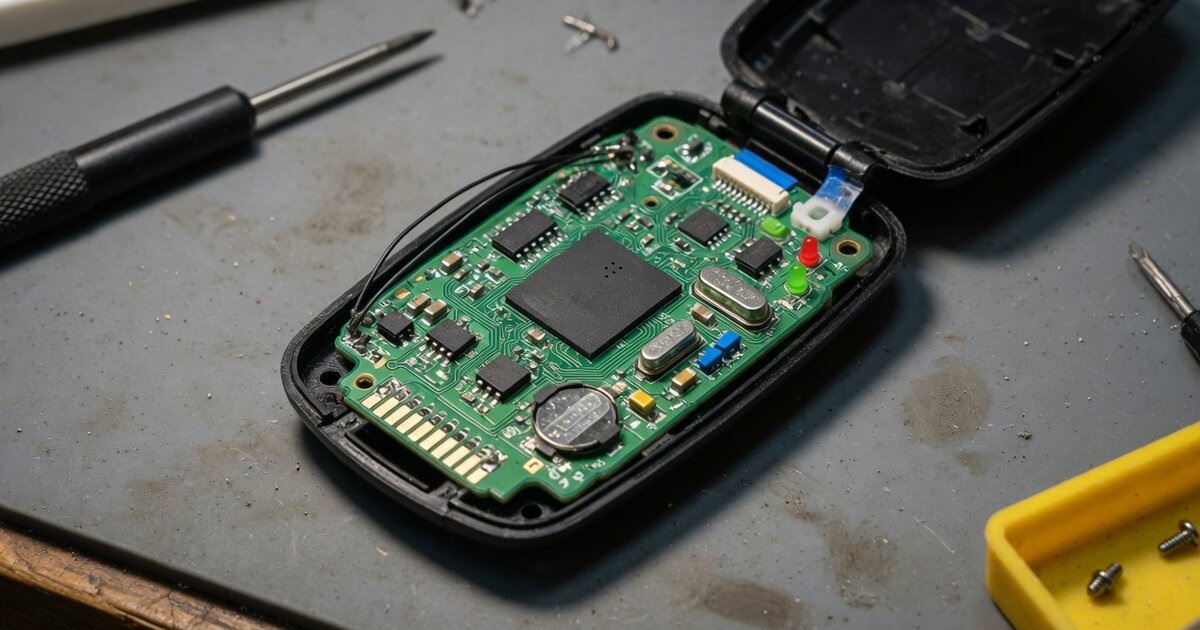
Search a parts catalog for "keyless transmitter" and the term gets used loosely for almost anything inside a car remote: the whole fob, the circuit board, or a specific radio component. Technically, it is the radio-frequency (RF) circuit inside a key fob that sends a signal to the vehicle's receiver when a button is pressed, responsible for locking, unlocking, opening the trunk, and triggering the panic alarm from a distance. Understanding what this component actually does — and what it does not do — clears up one of the most persistent points of confusion in the car key world.
This guide covers where the transmitter sits inside a typical fob, how it relates to the separate transponder chip used for engine immobilization, and what usually goes wrong when a remote stops responding. For a broader walkthrough of the whole system, see How Car Keyless Entry Remotes Actually Work.
Transmitter vs transponder: what's the difference
These two words sound alike and live inside the same plastic fob, which is exactly why they get mixed up so often. They are not the same part, and they do not do the same job.
The transmitter is an RF circuit, typically operating in the UHF band, that sends a wireless signal to a receiver module in the vehicle. In North America and Japan, remote keyless entry systems most commonly use 315 MHz; in Europe, 433.92 MHz is standard, with the 868 MHz band also used to handle growing demand for RF spectrum. Newer smart-key systems add a Bluetooth Low Energy (BLE) radio at 2.4 GHz for phone-as-key features. The transmitter needs a battery to operate, which is why every key fob has a small coin cell (commonly a CR2032) inside it. Press a button, and the transmitter sends a coded burst — usually a rolling code that changes with every transmission — which the vehicle's receiver checks before triggering the door locks, trunk release, or alarm.
The transponder chip is a different piece of electronics, and its name is literally a contraction of "transmitter" and "responder." It is a small, usually passive, RFID chip embedded in the key blade that needs no battery at all. When the key is inserted into the ignition, or held close to a proximity sensor, an antenna ring built into the steering column energizes the chip and reads back an encrypted ID code. The engine control unit (ECU) or a dedicated immobilizer module checks that code before allowing the engine to start; if it does not match, the immobilizer cuts fuel or ignition and the car will not run, even if the correct-looking key physically turns in the lock.
Put simply: the transmitter operates the doors and alarm from a distance using a powered radio signal, and the transponder authorizes engine start using short-range passive RFID that needs no battery. A dead fob battery can kill remote lock/unlock while leaving the immobilizer unaffected, since the transponder still runs on inductive power from the ignition antenna ring. Many modern smart-key fobs bundle both functions — an RF transmitter for convenience features and a transponder for start authorization — inside one housing, which is why owners assume they are one part when they are really two systems sharing a case. Buyers shopping for aftermarket replacements need to match both functions, not just the look of the fob; see Aftermarket Keyless Remotes: Types, How They Work, and Buying Guide for buying considerations.
How it works and common failure points
A basic RKE transmitter circuit has a few core parts: a microcontroller that generates the rolling code, an RF oscillator tuned to the assigned frequency, a small printed antenna trace, and the coin-cell battery that powers it all. Pressing a button wakes the circuit, the microcontroller pulls the next code in its pre-synchronized rolling sequence, and the RF stage broadcasts it as a short burst. A receiver module in the vehicle — standalone or built into the body control module — listens on that frequency, checks the code against its own counter, and if it matches, actuates the locks or arms/disarms the alarm.
Most transmitter failures trace to a short list of causes. A weak or dead coin-cell battery is by far the most common: range drops before the fob stops working entirely, so standing right next to the car for the remote to respond usually points to a battery on its way out. Corroded battery contacts, often from moisture or a dropped remote, cause intermittent operation even with a fresh battery. A cracked board or failed solder joint on the antenna trace kills the transmitter outright, and no battery swap fixes that. Rolling-code desync — the fob's counter and the vehicle's expected counter drifting apart, usually from repeated presses out of range — can make a working transmitter appear dead until resynced. It is also worth remembering the receiver side: interference or a failing body control module can make every key for that vehicle stop working at once, a clue the fault sits in the car, not the transmitter.
Common mistakes to avoid
The single most common mistake is treating a non-responsive remote as an immobilizer problem, or vice versa. If the doors will not lock or unlock but the car starts fine once the key is in the ignition, the transmitter has failed and the transponder is unaffected — no need to touch immobilizer programming. The reverse is equally common: a car that cranks but will not start, despite the remote working fine, almost always points to the transponder or immobilizer, not the RF transmitter.
Another frequent error is buying a replacement fob by shell shape or button layout alone, without confirming the correct transmitter frequency and rolling-code protocol, then being surprised when programming fails or range is poor. It is also a mistake to assume every dead-battery symptom needs professional diagnosis — a fresh coin cell resolves a large share of "key fob stopped working" complaints and costs almost nothing to rule out first. On the security side, some owners overlook that any RF transmitter can, in principle, be intercepted or relayed; anyone concerned about relay-style theft should look at practical mitigation, covered in Do Faraday Pouches Prevent Keyless Relay Theft, and How Do You Test One, rather than assume the transmitter itself is unsafe to use.
Frequently asked questions
Is a keyless transmitter the same thing as a key fob?
Not exactly. The key fob is the whole handheld device — the plastic housing, buttons, battery, and circuit board. The transmitter is one component inside that fob: specifically the RF circuit that sends the lock/unlock signal. A fob can contain a transmitter, a transponder, or both, depending on the vehicle.
Does a weak key fob battery affect the immobilizer as well as the remote?
Usually not. The transponder chip that authorizes engine start is typically a passive component powered by the ignition's antenna ring, not by the fob's battery. A dead battery commonly kills remote lock/unlock range while leaving start authorization unaffected, though this depends on the specific system design.
What frequency do most keyless transmitters use?
In North America and Japan, 315 MHz is the common standard; in Europe, 433.92 MHz is typical, with 868 MHz also used. Bluetooth Low Energy at 2.4 GHz has become common in newer smart-key systems for phone-as-key and some passive-entry functions.
Why does my key fob only work when I stand right next to the car?
Reduced range is the classic early symptom of a failing coin-cell battery, since a weakened battery can no longer power a full-strength RF burst. Corroded battery contacts or a cracked circuit board can produce similar symptoms even with a fresh battery.
Can a bad transmitter stop my car from starting?
On most vehicles, no — the transmitter only controls remote functions like locking, unlocking, and the alarm. Engine start authorization is handled separately by the transponder chip and immobilizer system, so a dead remote battery typically does not prevent the engine from starting once the key is in the ignition or the fob is inside the cabin for a push-button system.
Why do some replacement fobs fail to program even though they look identical to the original?
Shell and button layout can match while the internal transmitter frequency, chip type, or rolling-code protocol differs, which is enough to prevent successful pairing with the vehicle's receiver. Confirming the exact part or FCC ID compatible with the specific make, model, and year avoids this before buying.