Automotive Computer Chips: What Actually Runs a Modern Car
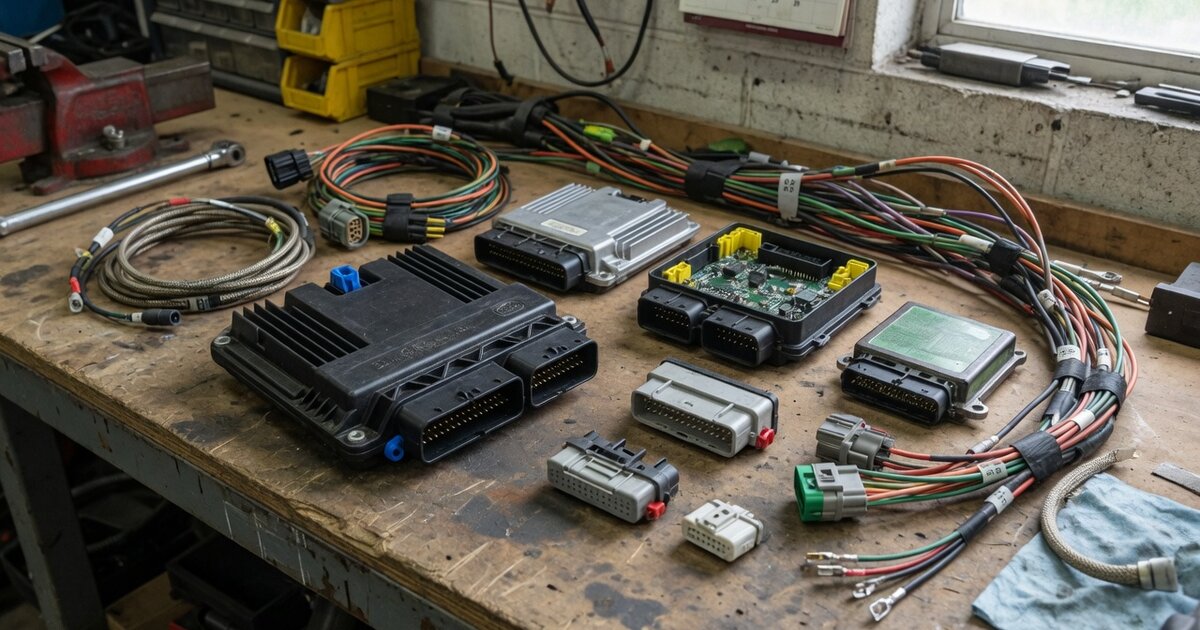
Search for "automotive computer chips" and you will run into two very different worlds. One is the aftermarket world of plug-in "performance chips" sold on Amazon and eBay, promising extra horsepower for thirty dollars. We already took that world apart in Which Performance Chips Actually Work: A Skeptical Buyer's Guide, and if that is what brought you here, that article is the one you want. This article is about the other world: the real semiconductor hardware that genuinely runs a modern car, whether or not anyone ever plugs a tuning gadget into it. No consumer product is involved here at all -- just the microcontrollers, sensor chips, and control modules that make a car start, steer, brake, shift, and report a fault code in the first place.
A modern vehicle is, functionally, a distributed computer network on wheels. Depending on the source and the vehicle's trim level, estimates for the number of separate electronic control units (ECUs) in a single car range widely -- some put basic vehicles at roughly 20 to 30 ECUs, mid-range vehicles at 30 to 70, and heavily optioned or luxury vehicles at 70 to 100 or more, with some industry write-ups citing totals as high as 150 across the full range of vehicle classes. Those numbers vary a lot by source and by how strictly "ECU" is defined, so treat any single figure as a rough range rather than a fixed spec. What is consistent across sources is the direction of travel: automakers are increasingly consolidating many small ECUs into fewer, more powerful domain and zonal controllers, even as the total computing power in the car keeps rising.
The chips and computers that actually run a car
Each ECU is built around at least one automotive-grade microcontroller (MCU) -- the actual chip doing the computing -- paired with flash memory to store its firmware and calibration data, analog-to-digital conversion circuitry to read sensor voltages, power-supply regulation, and a communication interface for the vehicle's internal networks (CAN, LIN, FlexRay, or increasingly automotive Ethernet). The MCUs themselves come from a small number of specialist semiconductor suppliers -- Infineon, NXP, STMicroelectronics, Texas Instruments, Renesas, and Microchip account for most of the automotive MCU market. These are not general-purpose consumer chips; they are qualified to automotive reliability standards for temperature range, vibration, and lifespan, and safety-critical modules often run dual- or triple-core designs so the system can detect a computational fault before it becomes a dangerous one.
What people usually mean by "the engine computer" is what the industry actually calls the ECM (Engine Control Module) or, on most modern vehicles, the PCM (Powertrain Control Module), which merges engine and transmission control into one unit -- the terminology and the reasons manufacturers split or combine these functions are covered in detail in ECM and PCM Meaning: What These Automotive Acronyms Stand For. But the ECM/PCM is just one module among many. A modern car also carries a Transmission Control Module (TCM) where it isn't merged into the PCM, an ABS/traction control module managing wheel-speed sensors and brake actuation, an airbag or SRS module that processes crash-sensor data in milliseconds and decides whether to fire pyrotechnic restraints, a Body Control Module (BCM) that handles lighting, door locks, window lifts, and increasingly the immobilizer and key-authentication logic, and an infotainment system built around a much more powerful automotive System-on-Chip (SoC) -- closer in complexity to a smartphone processor than to a simple MCU -- running the touchscreen, navigation, and connectivity stack. Layered on top of all of this are dozens of individual sensor chips: wheel-speed sensors, oxygen sensors, MAP/MAF sensors, wheel-position and crankshaft/camshaft sensors, tire-pressure sensors, and, on newer vehicles, camera and radar processing chips for driver-assistance features. Each of these talks to the rest of the network over the vehicle's internal bus rather than working in isolation.
Why this matters for diagnostics and key/immobilizer work
For anyone doing real diagnostic or key-programming work, this hardware picture is not academic -- it explains what a scan tool is actually talking to. When a technician pulls codes or reprograms a module, they are communicating over CAN with a specific ECU's microcontroller, reading or writing to its flash memory through a defined protocol (often UDS, sometimes manufacturer-specific). Immobilizer and key-programming tasks in particular live inside the BCM or a dedicated immobilizer module, which stores the cryptographic keys and challenge-response logic that authenticate a transponder key before the PCM will allow the engine to start. Understanding that this is real, purpose-built silicon -- not a generic chip that can be swapped for a cheaper one -- is also why legitimate reprogramming tools differ so sharply from the aftermarket gadgets covered elsewhere on this site; the piggyback, flash, and standalone approaches used by actual tuners and technicians, explained in ECU Tuning Tools: Piggyback, Flash, and Standalone Options Explained, work by directly reading or rewriting the manufacturer's own calibration data on the real MCU, rather than intercepting a signal externally.
Common misconceptions
The biggest misconception is conflating "a chip" as a single physical part with "the car's computer" as a whole system. A car does not have one chip that runs everything; it has a network of dozens of specialized computers, each built around its own microcontroller or SoC, cooperating over a shared bus. A second misconception is assuming any of this hardware is off-the-shelf consumer electronics -- automotive-grade parts go through qualification testing well beyond what a typical PC or phone chip sees, which is part of why automotive semiconductors are comparatively expensive and slow-moving compared to consumer tech. A third misconception, and the one most relevant to search intent around this topic, is assuming that a small inline "performance chip" gadget is somehow representative of, or installed inside, this real hardware -- it is not; those plug-in products sit on a connector outside the ECU and manipulate a signal, they do not become part of the vehicle's actual computer architecture.
Frequently asked questions
How many computer chips are in a modern car?
There is no single agreed number. Estimates for the number of separate ECUs range from roughly 20-30 on basic vehicles up to 70-100+ on heavily optioned or luxury models, with some industry figures citing totals as high as 150 across the market. Each ECU typically contains at least one microcontroller plus supporting chips, so the total individual semiconductor count is considerably higher than the ECU count alone.
What is the difference between an ECU and a microcontroller?
The microcontroller (MCU) is the actual processing chip -- the silicon that executes code. The ECU is the complete module: a circuit board that houses the MCU along with memory, power regulation, input/output circuitry, and a communication interface, packaged in a housing and wired into the vehicle's network. One ECU can contain more than one MCU, particularly in safety-critical systems.
Who makes the chips inside automotive ECUs?
A small group of specialist semiconductor companies dominates automotive microcontroller supply, including Infineon, NXP, STMicroelectronics, Texas Instruments, Renesas, and Microchip. These suppliers build automotive-qualified parts to reliability standards that differ substantially from consumer-grade electronics.
Is the engine computer the same as the ECM or PCM?
Informally, yes -- when people say "the engine computer" they usually mean the ECM or PCM. Technically, the ECM handles engine-specific control while the PCM combines engine and transmission control in one module; which term applies depends on the manufacturer and platform.
Does a plug-in performance chip replace or reprogram the real ECU chip?
No. A plug-in performance chip is a separate external device that intercepts or modifies a sensor signal (commonly boost or fuel-related) before it reaches the ECU; it does not access, reprogram, or become part of the vehicle's actual microcontroller or its stored calibration data.
Why do immobilizer and key-programming tools need to talk to specific modules?
Because the cryptographic keys and authentication logic for starting the engine are stored in specific hardware -- typically the BCM or a dedicated immobilizer module, working together with the PCM. A programming tool has to communicate with the correct module over the vehicle's bus using the correct protocol to read or write that data; there is no generic "the chip" that a single universal signal can address.