Which Performance Chips Actually Work: A Skeptical Buyer's Guide
Search for "performance chip" on any marketplace and you will find dozens of small plastic devices, priced anywhere from fifteen to sixty dollars, that plug into a car's OBD2 port and promise an instant jump in horsepower, torque, and fuel economy. The questions people actually type into search engines — "do performance chips really work" and "are performance chips worth it" — exist because the marketing and the lived experience so often don't match. This guide looks at what these plug-in devices are physically capable of doing, what independent teardowns and forum-documented tests have found, and where the real, verifiable performance-tuning market actually lives.
How plug-in performance chips actually work
The OBD2 port is a standardized diagnostic connector, required on every U.S. car sold since 1996, that gives a scan tool access to the vehicle's data bus so it can read trouble codes and live sensor values. An OBD2 scanner uses that same port to talk to the engine control module, but reading data is a very different job from rewriting it. Legitimate performance tuning changes the actual calibration tables — fuel, timing, boost, shift points — stored inside the ECM or PCM, and doing that safely requires software written for a specific engine, transmission, and often a specific model year.
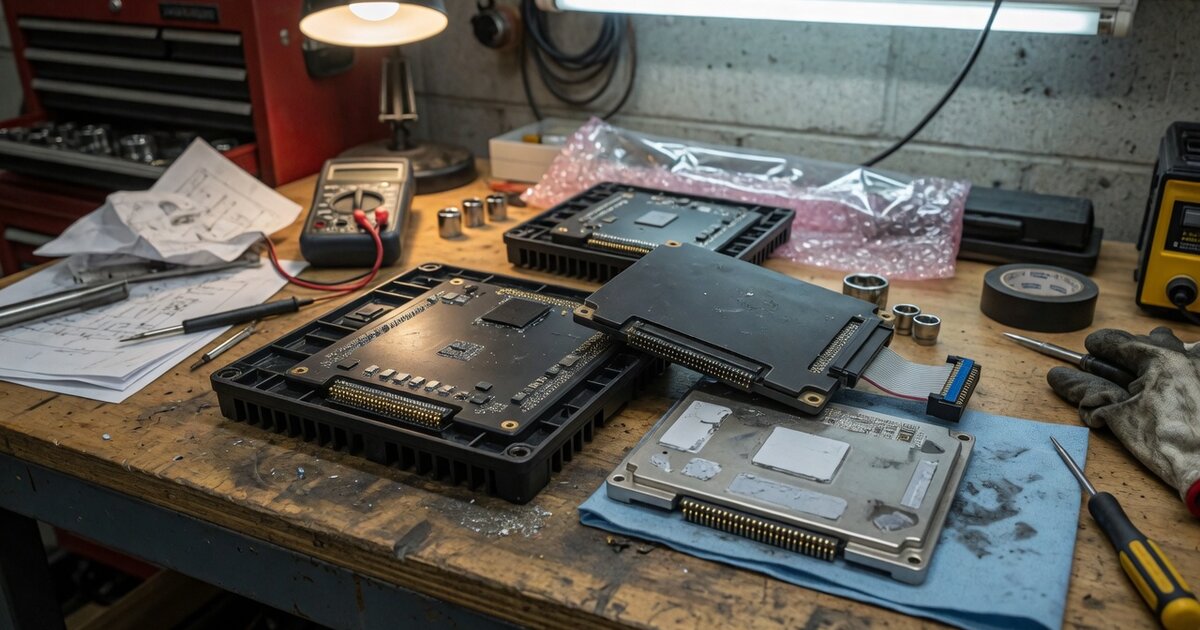
Many cheap plug-in "chips" sold as universal fits for "any vehicle 1996 and newer" don't do that at all. Independent teardowns of several popular units (Thorton Top Speed, SuperOBD, and similar devices, documented on sites that photograph and reverse-engineer these products) found circuit boards holding nothing more than a capacitor, a handful of resistors, and a blinking LED. The pins that would carry data are not wired to anything capable of writing to the bus; the device draws a small amount of power and lights up, and that is the entire function. A separate device sold as a cigarette-lighter "fuel saver" was found to contain the same category of components — a capacitor and resistors with no plausible mechanism to affect combustion, fueling, or electronics anywhere in the car.
That doesn't mean every OBD-port device is fake. Genuine piggyback modules intercept and alter real sensor signals — mass airflow, manifold pressure, throttle position — before they reach the factory computer, feeding it slightly different numbers so it recalculates fueling or boost. But a real piggyback has to be built and calibrated for one engine and one sensor package; a generic box claiming to work identically on a four-cylinder economy car and a turbocharged truck cannot be doing genuine signal manipulation, because the correction factors that are safe on one engine would be wrong on another.
What the evidence shows
Teardown analyses of several mass-market OBD2 chips found no components capable of altering engine behavior at all — just an LED circuit designed to reassure the buyer that "something is happening." Owners who tested these products past the manufacturer's own recommended break-in mileage reported no measurable change in fuel economy, throttle response, or seat-of-the-pants performance. Price comparisons make the picture clearer still: several of these chips retail for thirty to forty dollars on major marketplaces while the identical-looking hardware is available direct from Chinese manufacturers for around two dollars, which is difficult to square with claims of proprietary tuning technology.
Where real dyno-documented gains do show up in the tuning world, they come from vehicle-specific calibration work, not a universal plug-and-forget gadget. Turbocharged and supercharged engines have more headroom for a tuner to safely add boost, advance timing, and richen fueling within the factory hardware's limits, which is why forced-induction platforms are where custom tunes tend to show the largest rear-wheel gains on a dyno. Naturally aspirated engines, lacking that boost lever, have far less to give without physical modifications, and owners of NA cars who tried inexpensive chips consistently describe no repeatable, dyno-confirmed difference.
The other consistent thread is the placebo effect. A driver who has just spent money on a part marketed to sharpen throttle response is primed to notice exactly that, and subjective seat-of-the-pants impressions are unreliable without a controlled back-to-back dyno pull. When owners have actually strapped a car to a dyno before and after installing a bargain OBD2 chip, the runs have not shown the gains printed on the packaging.
Legitimate alternatives to consider
If the goal is a real, measurable increase in power, the tools that reliably deliver one work by actually rewriting or intercepting the data that controls the engine, not by lighting up an LED. A full ECU flash (also called reflashing or a custom tune) uses vehicle-specific software to modify the actual maps stored in the ECM or PCM, done at a shop with a dyno or through a handheld programmer from an established tuning brand built for a particular make and model. A properly calibrated piggyback tuning box sits between the factory sensors and the ECU and adjusts real signals, but a reputable one is engineered for a specific engine rather than sold as a universal fit. Standalone aftermarket ECUs go further, replacing the factory computer entirely, and are generally reserved for heavily modified or race-only builds. The differences between these approaches — what each one physically changes, how reversible it is, and what calibration it needs — are covered in more detail in this breakdown of piggyback, flash, and standalone tuning options.
Whichever route is being considered, the same test applies: ask whether the seller can show independent, vehicle-specific dyno results, not just a percentage claim on the box. A tuner who can produce before-and-after dyno graphs for the exact engine in question is offering something fundamentally different from a universal chip whose only documented internal component is an LED.
Frequently asked questions
Do performance chips really increase horsepower?
It depends entirely on what the device does inside. Teardowns of several popular OBD2 plug-in chips found no components capable of altering engine calibration, fueling, or timing — just a small circuit built to blink an LED. Genuine gains come from tools that actually rewrite ECU calibration data or intercept real sensor signals, calibrated for a specific engine, not from a universal device claiming to fit any car built after 1996.
Why do some drivers feel a difference after installing a cheap chip?
Expectation plays a large role. A driver who has just paid for a part marketed as improving throttle response is primed to notice exactly that sensation, and subjective driving impressions are unreliable without a controlled back-to-back test. Owners who have run before-and-after dyno pulls on inexpensive plug-in chips have not documented the gains described in the marketing.
Are performance chips worth it?
A universal plug-in chip sold for a wide range of vehicles is unlikely to be worth the money, based on independent teardowns showing no functional tuning hardware inside. A vehicle-specific tune, whether delivered through an ECU reflash or a properly calibrated piggyback box built for that particular engine, is a different product category and is where documented dyno gains actually come from.
What's the difference between a performance chip and a tuning box?
A "performance chip" in the cheap OBD2-plug-in sense typically has no real connection to the vehicle's data bus. A legitimate tuning box, by contrast, physically intercepts signals from sensors like the mass airflow or manifold pressure sensor and alters them before they reach the ECM or PCM, changing how the factory computer calculates fueling or boost — but only when it has been engineered and calibrated for that specific engine.
Can a performance chip damage my engine?
A device that isn't actually wired into the data bus generally can't do anything to the engine at all, for better or worse. The real risk sits with generic sensor-signal devices that alter voltage readings without being calibrated for the specific vehicle; feeding the ECU incorrect airflow or pressure data outside safe limits can lean out fueling or push boost beyond what the hardware was designed for.
How can I tell if a performance chip is legitimate before buying?
Look for a product built and calibrated for the specific year, make, model, and engine rather than one advertised as a universal fit for "any vehicle since 1996." Ask whether the seller can show independent, vehicle-specific dyno results rather than a flat horsepower percentage on the packaging, and be skeptical of identical-looking hardware sold under several different brand names at wildly different prices.