Bidirectional Scan Tools with Airbag Reset: What to Look For
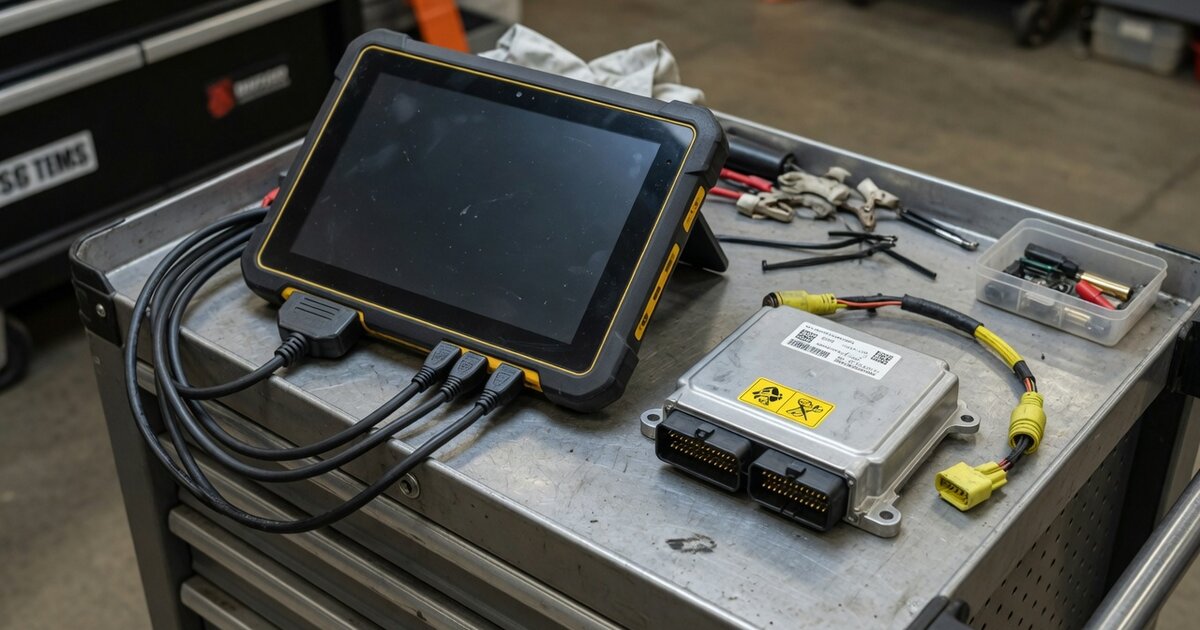
Searches that pair "car diagnostic" with "airbag reset" point to a real gap in how these tools get marketed. Most buyers already know what a bidirectional scan tool is for engine and transmission work, and they've separately heard that airbag/SRS lights sometimes need more than a code clear. Tools promising both in one box are attractive, but the box rarely explains which SRS functions are truly bidirectional and which are a code reader with an airbag menu bolted on. This guide is the evaluation criteria: what "bidirectional" needs to mean for airbag work specifically, what to verify before paying for a combined tool, and where buyers commonly get misled.
What "bidirectional" actually means and why it matters here
A standard scanner is a one-way instrument: it pulls trouble codes and live data from the vehicle's modules and shows them to you, and nothing you do with the tool changes what the module is doing. A bidirectional scan tool also works the other way — it can send a command that makes a module do something, such as cycle a relay, run a fuel pump, or trigger an actuator, so a technician confirms a component actually responds instead of inferring health from a code alone. That distinction, covered in more depth in our guide to choosing an OBD2 scanner, is the whole reason "bidirectional" is worth paying extra for.
Airbag/SRS work leans on the same principle, but the stakes are different. After replacing a sensor, a clockspring, or a seat occupancy module, the restraint control module doesn't just need its fault code erased — it typically needs a command that tells it to re-initialize, self-check, and confirm the new component is recognized. A code reader that only clears the stored DTC can make the warning light go out temporarily without that handshake ever completing, and the light — or a non-functional restraint system — comes back. That's the mechanism our article on what an airbag reset service actually does walks through, worth reading if you're unsure whether your situation needs a reset at all. A genuinely bidirectional tool is the one that can send the re-initialization command, not just erase the code — exactly why "bidirectional" and "airbag reset" show up together in searches.
What to check before buying a combined tool
Marketing pages for combo tools tend to bundle "bidirectional diagnostics" and "airbag reset" as if every feature applies to every vehicle. In practice, coverage is uneven and worth checking item by item before you buy:
- Whether the airbag function is a reset or just a code clear. Look for "SRS reset" or "module re-initialization," not only "read/erase SRS codes." Only one of the two reliably keeps a light off after a repair.
- Vehicle-specific coverage for the SRS system, separate from general OBD2 coverage. A tool can be strong on bidirectional engine tests for a make while having thin SRS-module support for that same make. Check the coverage list for the airbag module specifically, not just the headline "covers X makes" claim.
- Whether crash data clearing is included, and under what conditions. Clearing stored crash data after a deployment is a narrower, sometimes vehicle-locked function — on many platforms the restraint module records deployment data in a way ordinary OBD2 commands can't touch, and clearing it needs a dedicated procedure or hardware access to the module. If that's why you're buying, confirm explicitly that the tool does it.
- Whether functions need an annual subscription. Bidirectional and SRS-reset functions are frequently locked behind paid updates after the first year. Price the subscription into any comparison.
- Vehicle-specific adapters or connectors. Some brands require a dedicated cable or a separate software license for a particular manufacturer's airbag system rather than working through the standard OBD2 port. Confirm the connector and license situation for your make before buying.
- How the bidirectional test list is documented. A reputable listing shows which actuations and resets are supported per system and per vehicle, not a generic "bidirectional control" bullet. If you can't find that list, treat the claim as unverified.
Several established scan-tool lines advertise this combination in some form — general-purpose bidirectional platforms that add an ABS/SRS reset function alongside engine and transmission tests, and dedicated ABS/airbag units built around restraint-system reset and steering-angle calibration. A full bidirectional platform gives you actuation tests across systems plus airbag reset as one of many functions; a dedicated airbag/ABS unit trades that breadth for deeper SRS coverage. Which fits depends on whether airbag work is occasional or core to your workload — our roundup of airbag reset software technicians actually use covers the dedicated-tool side in more detail.
Common mistakes to avoid
The most frequent error is assuming "airbag reset" on the box means the tool can clear crash data after a deployment. For a meaningful share of vehicles it can't — deployment data is deliberately hard to erase without a dedicated procedure, and a generic bidirectional scanner's SRS menu is usually built for post-repair re-initialization, not crash-data clearing. Confirm which one you actually need before buying for that purpose.
A second mistake is buying on a brand's reputation for engine-side bidirectional tests without checking SRS-module support for the specific make and model in question. Bidirectional capability isn't uniform across a manufacturer's whole vehicle list; a tool excellent on domestic engine actuation tests can have limited SRS coverage on an import brand, or the reverse.
A third mistake is ignoring the ongoing cost of coverage updates. Bidirectional and airbag-specific functions are commonly the ones that stop being current once a subscription lapses — a tool that looked inexpensive at purchase can cost more over two or three years than a pricier tool with different licensing terms.
Finally, buyers sometimes skip verifying that the tool documents its actual test list, relying on a general "bidirectional" or "airbag reset" claim on the packaging. Ask for the specific coverage/function list for your vehicle before paying — a claim that can't be checked against a documented list deserves caution.
Frequently asked questions
Is every bidirectional scan tool able to reset an airbag module?
No. Bidirectional capability is usually built system by system, and a tool can have strong support for engine and transmission actuation while offering only basic SRS code reading, or none at all, depending on the vehicle. Check the SRS/airbag line item in the coverage details rather than assuming it's included because the tool is labeled bidirectional.
What's the difference between clearing an airbag code and doing a full SRS reset?
Clearing a code erases the stored fault from memory, which can make the warning light go out immediately but doesn't address why the code was set. A full SRS reset sends a command that makes the restraint module re-initialize and re-check its connected components — usually needed after replacing a sensor, pretensioner, or clockspring so the module actually recognizes the repair.
Can a bidirectional tool clear crash data after an accident?
Sometimes, but it's not guaranteed and depends on the vehicle. Many restraint modules store deployment data in a way that's intentionally resistant to clearing through the OBD2 port, and doing so can require a dedicated procedure or direct access to the module. Don't assume a general bidirectional tool handles this; check for it explicitly if it's why you're buying.
Do I need a subscription to use the airbag/SRS functions?
Often, yes. Many scan-tool makers include a year of software updates with the initial purchase and then charge annually to keep bidirectional and SRS-specific functions current. Factor that into a price comparison rather than judging tools on the upfront cost alone.
Which brands market bidirectional diagnostics combined with airbag reset?
Several well-known scan-tool brands sell platforms that combine bidirectional/active-test diagnostics with an ABS/SRS reset function, alongside separate lines built specifically around ABS and airbag service resets and steering-angle calibration. Coverage and depth of the SRS function vary by product tier and vehicle, so treat the combination as a research starting point, not a guarantee it covers your specific vehicle.
Is a bidirectional tool overkill if I only need to turn off an airbag light?
If the fault has genuinely been repaired and the module just needs telling, a dedicated ABS/airbag reset tool is usually cheaper and simpler than a full bidirectional platform built for engine and transmission tests too. A full bidirectional tool makes more sense if airbag work is one of several systems you regularly diagnose, not the only one.