ECU Chip: What It Is Inside the Control Unit
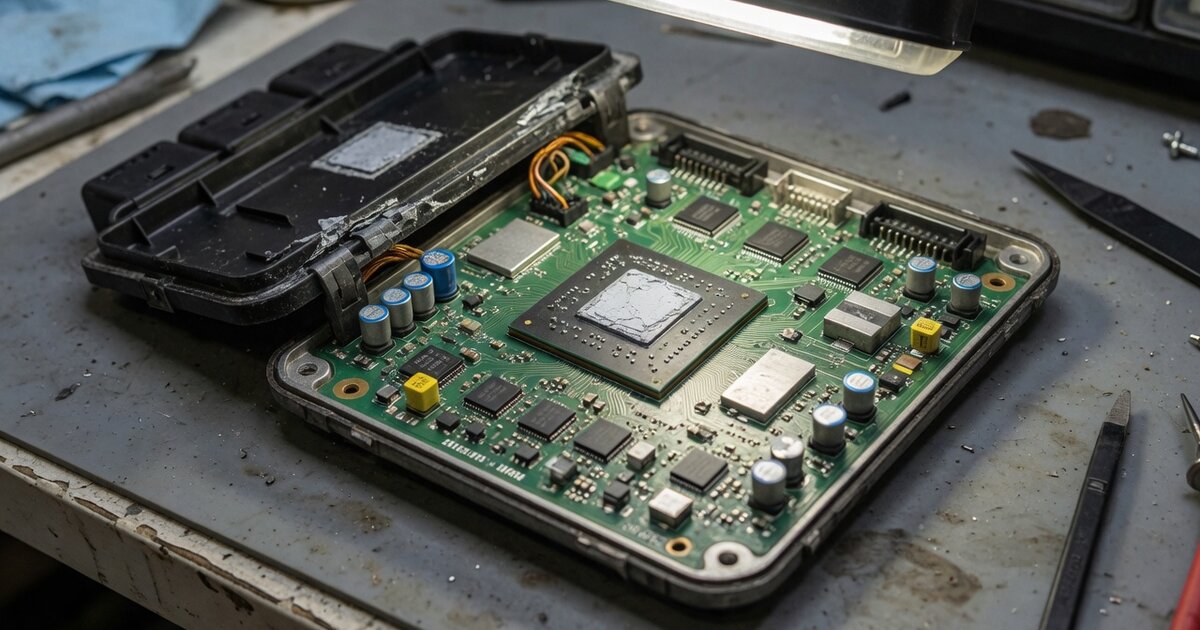
Search for "ECU chip" and most results talk about the whole control unit or about performance chip tuning. Taken literally, though, the ECU chip is a specific physical thing: the microcontroller and memory device soldered onto the board inside the ECU housing, holding the firmware that runs the engine and the calibration data that tells it how to run. Knowing what that chip actually is — and how technicians read, write, or replace it — matters most when OBD-based reprogramming isn't an option: a salvage-yard ECU that needs cloning, a control unit that won't communicate over the diagnostic port, or a bricked module needing recovery. This guide stays at the hardware level: what's physically inside the housing, how chip-level programming differs from ordinary reflashing, and where people get it wrong.
What's Actually Inside an ECU
Open up a typical engine control unit and underneath the potting compound or conformal coating is a board carrying one central component: a microcontroller. This is the actual "chip" people mean when they search the term — an integrated circuit combining a processor core, input/output circuitry, and, on most modern units, the memory storing both the operating firmware and the calibration tables (fuel maps, ignition timing, sensor curves) that make one application of a control unit different from another running the same base software.
Memory technology has changed across generations. The earliest engine control computers stored their program on a separate ROM or EPROM chip — a UV-erasable device that had to be physically removed, erased under an ultraviolet lamp, and reprogrammed on a bench programmer before being resoldered onto the board. That constraint is the real origin of "chip tuning" as a term: there was no other way to change the program than to swap the physical chip.
Modern microcontrollers fold the program memory into the same package as the processor, as embedded flash rather than a separate chip. Flash stores the bulk firmware and calibration data in large blocks, which suits whole-firmware updates but has a limited rewrite life. Alongside it, many ECUs still carry a small separate EEPROM chip for data that changes more often: mileage, adaptation values, immobilizer and security codes, VIN-linked configuration. EEPROM erases and rewrites a byte at a time and tolerates far more write cycles than flash, which is why it suits small values updated repeatedly rather than the firmware image itself.
For how all of this fits together as a working module, the broader overview in What Is an ECU? A Plain-Language Guide to the Control Unit in Your Car covers the rest of the housing — connectors, drivers, power regulation — that surrounds this chip.
Chip-Level Programming vs OBD Reprogramming
Nearly all routine ECU work today happens over the On-Board Diagnostics port. A tool connects to the standard diagnostic connector, talks to the ECU using its existing communication protocol, and sends new firmware or calibration data through the same channel the ECU already uses to report fault codes. Nothing is opened or desoldered, and this is what most people mean by "reprogramming" or "flashing" now — also the territory of feature-level work like ECU Coding Explained: What It Means and When You Need It, which configures or enables functions rather than replacing the firmware image itself.
Chip-level access is a different discipline, reserved for cases where OBD isn't available or isn't sufficient. Programming tool makers generally describe two variants: "bench mode," which connects a programmer directly to the ECU's own connector pins with the unit removed from the car but still closed — faster and lower-risk than opening the housing, and enough to read or write the chip's contents in most cases; and "boot mode," where the housing is opened and the programmer talks to the microcontroller's own pins directly, bypassing the ECU's normal communication layer entirely. That's the closest thing to true chip-level work, needed when the microcontroller won't respond through any higher-level channel at all.
Typical reasons a shop drops to chip level: a salvage-yard ECU needs its immobilizer data cloned onto a replacement unit; a control unit has corrupted firmware and won't boot far enough to answer OBD commands; a locked module needs its memory read for diagnosis rather than reflashing; or a technician needs a full memory dump before installing a used part, to confirm what's actually stored on the chip rather than trusting a label. None of this is "chip tuning" in the performance sense, though the same access methods are what performance chip tuning historically relied on before OBD flashing became the default — background covered in ECU Tuning Tools: Piggyback, Flash, and Standalone Options Explained.
The trade-off is real: chip-level access needs the correct pinout, connector, and voltage for that microcontroller family, and there's no protocol-level safety net the way there often is over OBD. Get it wrong, and the fallback isn't "try OBD instead" — there may not be one.
Common Mistakes to Avoid
Skipping the backup. Before writing anything to a chip, its existing content should be read and saved in full. If a bench or boot session goes wrong, that saved image is often the only way back — writing over a chip with nothing saved first turns a routine job into a bricked module.
Treating identical part numbers as identical hardware. Revisions change during a production run — a different microcontroller, memory chip, or pinout — even when the label on the housing hasn't changed. A file that worked on one sample isn't guaranteed to match another unit with the same part number.
Ignoring power stability during a write. A voltage drop partway through writing to flash or EEPROM can corrupt the memory mid-write, a worse outcome than an interrupted read. Bench and boot sessions need a stable supply for the full duration of the write.
Confusing chip-level access with chip tuning. Reading or cloning a chip for immobilizer or module-replacement purposes is not the same task as performance remapping, even though both use similar hardware access. Applying a tuning workflow to a cloning job, or the reverse, is an avoidable mix-up.
Defaulting to boot mode when bench mode would do. Opening the housing adds risk for no benefit if the bench connector was always going to work.
Frequently asked questions
What's the difference between an ECU chip and the ECU itself?
The ECU is the complete module — housing, connectors, board, and power and signal circuitry. The "chip" is one component on that board: the microcontroller, and on many units a separate small memory chip, that stores the firmware and calibration data. Replacing "the ECU" means swapping the whole module; working on "the chip" means accessing that component's memory directly.
Can I replace just the chip inside a faulty ECU?
On older designs with a separate EPROM or EEPROM chip, technicians could sometimes desolder and replace just that component. On modern ECUs the program memory is usually built into the microcontroller package itself, so there's no separate chip to swap — a firmware or memory fault generally means reprogramming or replacing the whole microcontroller.
Why would a technician need to access the chip directly instead of using OBD?
Mainly when OBD isn't an option: the ECU won't communicate because of corrupted firmware, a salvage unit needs its data read or cloned before reuse, a module is locked in a way that blocks OBD-level reprogramming, or the job requires confirming what's actually stored on the chip rather than what a part number implies.
Is chip tuning the same as reading and writing the ECU chip?
They overlap in method but not purpose. Chip tuning means modifying calibration data for performance, historically by physically swapping a programmed chip and now mostly done through OBD flashing. Chip-level reading and writing is a broader access method used for cloning, recovery, and diagnosis as well as tuning — the technique is similar, but the goal is often completely different.
What tools are used for chip-level ECU work?
Dedicated bench and boot programmers that connect either to the ECU's own connector with the housing closed, or directly to the microcontroller's pins with the housing open — specialized tools built for specific microcontroller families and ECU platforms, distinct from the OBD-only flash tools used for routine reprogramming.
Is chip-level programming risky?
Yes, more so than OBD reprogramming. There's no protocol acting as a safety layer, so an incorrect pinout, wrong voltage, or interrupted write can permanently corrupt the chip with no OBD-based fallback to recover it. Backing up the original data before writing anything is the single most important precaution.