What Is an ECU? A Plain-Language Guide to the Control Unit in Your Car
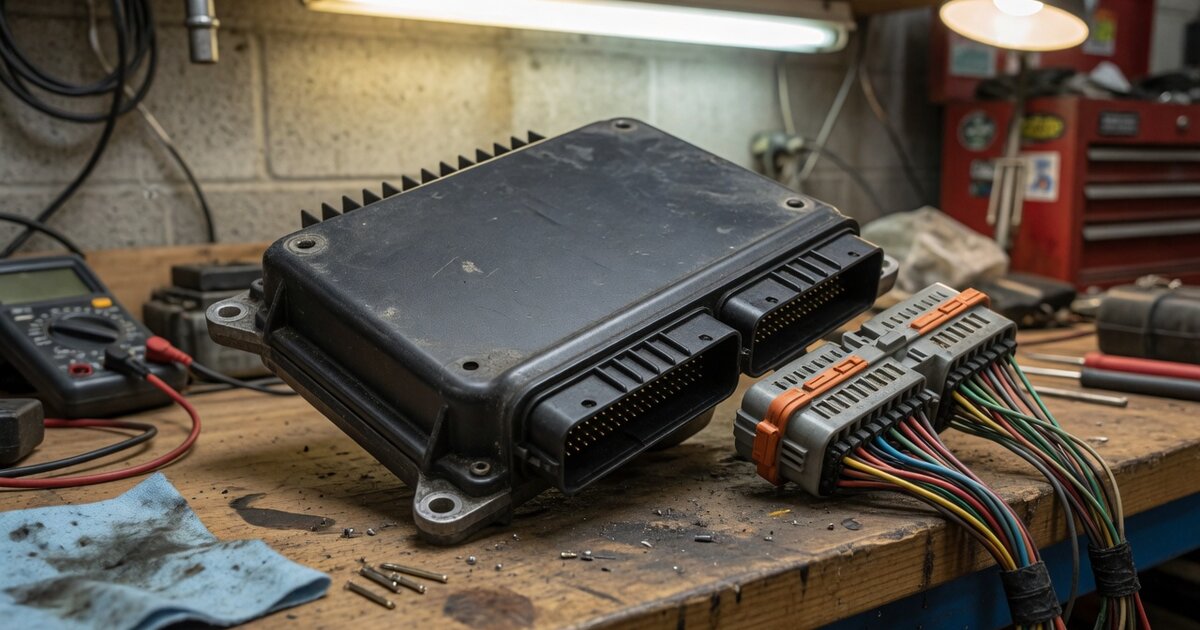
If you've popped the hood, plugged in a diagnostic scanner, or just heard a mechanic mention it, you've probably run into the term "ECU." Short for Electronic Control Unit (and often called the Engine Control Unit when talking specifically about the engine), an ECU is essentially a small onboard computer that watches what's happening in a vehicle and makes constant adjustments to keep it running the way it's supposed to. It reads signals from sensors scattered around the engine bay, compares that information against pre-programmed reference data, and then sends instructions to the parts of the car that actually do the work. This article is a general introduction to the concept for anyone new to the term. If you want a deeper technical breakdown of the engine-specific unit, its internal architecture, and the tradeoffs involved in servicing one, see our dedicated guide to the Engine Control Module (ECU/ECM).
What it does
At its core, an ECU runs a continuous loop: input, processing, output. Sensors positioned throughout the engine constantly measure things like intake air volume, coolant temperature, crank angle, throttle position, and oxygen levels in the exhaust. The ECU takes that raw sensor data and runs it against multidimensional reference tables (often called look-up tables or maps) that were calibrated by the manufacturer during development. Based on that comparison, it decides what needs to change right now, this instant, to keep the engine operating efficiently and within safe limits.
Those decisions get sent out as commands to actuators — the physical components that actually change how the engine behaves. Fuel injectors are told how much fuel to deliver and exactly when. Ignition components are told when to fire. Valves controlling airflow, exhaust gas recirculation, and various other subsystems are opened or closed by degrees. A simple example illustrates the whole process: when a driver presses the accelerator, a throttle position sensor reports the change, an airflow sensor measures the extra air entering the engine, and the ECU responds by adjusting the fuel injected to match — all within a fraction of a second, and all happening continuously while the engine runs.
Beyond the moment-to-moment adjustments, the ECU is also responsible for keeping emissions within regulatory limits, managing torque output, monitoring engine health, and storing diagnostic trouble codes when something falls outside expected parameters. That last function is why the ECU is the first place a technician looks when a check engine light comes on — it holds a running record of what the sensors have been reporting and which values triggered a fault.
How it relates to other systems
"ECU" is sometimes used loosely to mean any control unit in the vehicle, but most modern cars actually contain a whole network of them, each responsible for a different subsystem. The engine-focused unit is more precisely called the ECM (Engine Control Module) — and in practice the two terms are used interchangeably, with Japanese and Korean manufacturers tending to favor "ECU" and American manufacturers like GM tending to favor "ECM" for essentially the same component. When a single module handles both engine and transmission functions together, it's usually called a PCM (Powertrain Control Module) — effectively an ECM and a TCM combined into one housing.
The TCU or TCM (Transmission Control Unit/Module) is a separate computer dedicated to automatic transmissions. It uses inputs like wheel speed, turbine speed, and transmission fluid temperature to decide when and how to shift gears smoothly; manual-transmission vehicles don't need one, since the driver handles shifting directly. Then there's the BCM (Body Control Module), which is a different animal altogether — rather than managing the powertrain, it oversees electrical convenience features such as power windows, lighting, mirrors, and central locking, and in most modern vehicles it also plays a central role in the immobilizer system.
That immobilizer connection is worth understanding, because it's where control units intersect directly with key programming. In a typical setup, the transponder chip in a key communicates with the BCM, the BCM authenticates that signal, and only after that authentication succeeds does it signal the ECM to allow the engine to actually start. On some platforms this authentication is spread across several modules — the key, the ECU, the instrument cluster, and the transmission control unit may all need to be synchronized for the immobilizer to release. That's why replacing a BCM or ECU on a vehicle with an active immobilizer isn't just a matter of swapping hardware; the replacement module generally needs to be matched, coded, or programmed to the vehicle before the engine will start with the existing keys. If you're working through that kind of task, our companion pieces on ECU coding and ECU programming go into what each process actually involves and when each one applies.
Common mistakes to avoid
One of the most frequent mix-ups is treating "ECU" as a catch-all for every computer in the car. In casual conversation that's harmless, but in a diagnostic context it matters: a fault stored in the BCM won't necessarily show up when you're only pulling codes from the engine module, and a shifting problem rooted in the TCU won't be solved by anything done to the ECM. Knowing which module actually owns the symptom you're chasing saves a lot of wasted diagnostic time.
Another common error is assuming that any check engine light points to a failed ECU itself. In the overwhelming majority of cases, the ECU is working exactly as designed — it's reporting a fault it detected elsewhere, such as a failing sensor, a vacuum leak, or a worn actuator. The unit itself failing outright is comparatively rare. Jumping straight to replacing or reflashing the control unit before ruling out the sensors and wiring feeding it is a good way to spend money without fixing anything.
It's also a mistake to assume a used or replacement control unit will simply work once it's bolted in. Because these modules are frequently tied to the vehicle's immobilizer and sometimes to its VIN, an unmatched unit can leave a car unable to start even though every wire is connected correctly. Finally, people often use "coding" and "programming" as if they're the same operation; they overlap but aren't identical, and using the wrong one — or skipping it entirely — is a common source of comebacks in shops handling module replacements.
Frequently asked questions
Is an ECU the same thing as an ECM?
For practical purposes, yes. Both terms generally refer to the computer that manages the engine's fuel, ignition, and emissions functions. The naming difference is mostly a matter of manufacturer convention rather than a technical distinction.
What happens if the ECU fails?
Symptoms range from a car that won't start or won't idle correctly to stored fault codes, poor fuel economy, or the engine defaulting into a limited "limp" mode to protect itself. Because the ECU governs so many core functions at once, a genuine failure tends to produce broad, hard-to-ignore symptoms rather than one isolated issue.
Can a car run without an ECU?
No. On any modern fuel-injected vehicle, the ECU is essential — it's the component making the constant fuel, timing, and airflow decisions that let the engine run at all. Very old carbureted vehicles managed without one, but virtually nothing built in the last few decades can.
How many control units does a typical modern car have?
It varies widely by make, model, and trim level, but most current vehicles have well beyond a handful — separate modules commonly exist for the engine, transmission, body electronics, airbags, and various driver-assistance or comfort features, all communicating over an internal network.
Does replacing an ECU affect the car's keys or immobilizer?
Often, yes. Because many immobilizer systems rely on authentication between the key, the BCM, and the ECU, installing a new or used control unit typically requires that unit to be coded or programmed to the vehicle before the existing keys will start the engine.
What's the difference between ECU coding and ECU programming?
Broadly, coding refers to configuring settings and variant data on a module that's already loaded with the correct base software, while programming typically refers to writing or updating that underlying software itself. The two are related but distinct processes, and which one a given job needs depends on the situation — our linked guides above walk through both in detail.