ECU Decoder Tools: From Raw File to Readable Maps
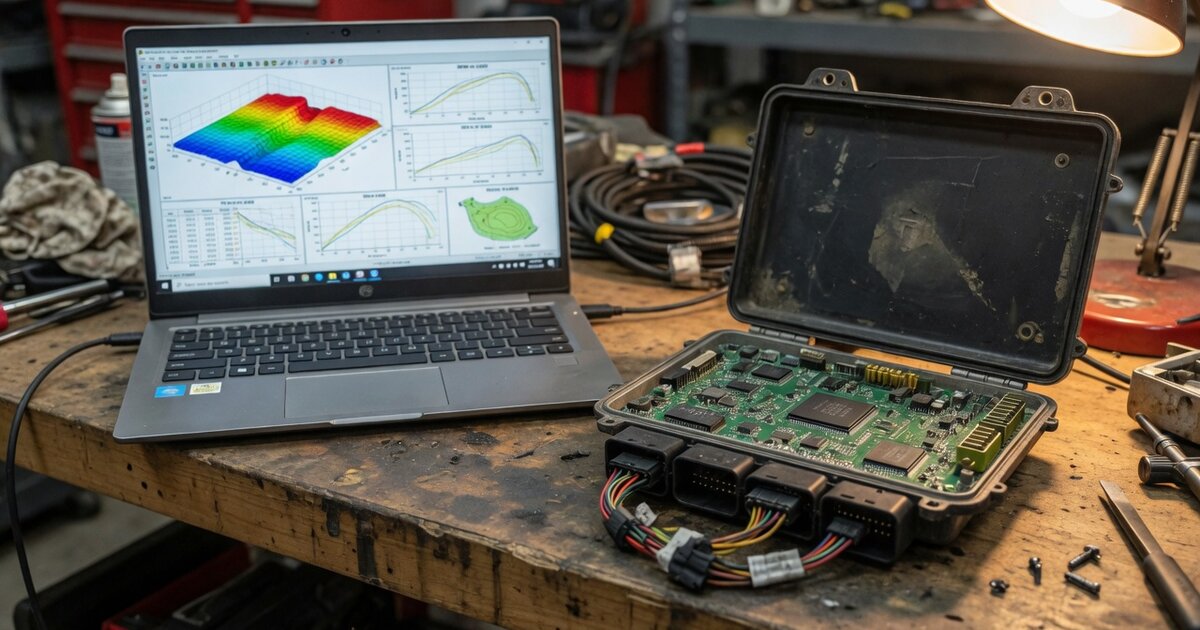
Extracting a raw file from an ECU and editing the values inside it are two distinct jobs, and there is a step in between that often gets skipped over in explanations of how tuning actually works: turning that raw file into something a human being can read. A freshly pulled ECU binary is just a long string of hexadecimal bytes — no labels, no axis names, nothing to indicate which few hundred bytes hold the ignition timing table and which hold an idle air correction curve. Decoding is the process that fills in those labels. It relies on a definition file that tells the software where each map sits inside the binary, how large it is, and how to convert the raw numbers into units that mean something — degrees, milligrams, percent. This article looks specifically at that translation step: what it involves, which tools handle it, and where people commonly get it wrong.
What ECU decoding actually means
A raw ECU dump on its own carries no metadata. Two different calibrations for the same engine, sitting one byte apart in memory, look identical in a hex editor unless something tells the software what it is looking at. Decoding supplies that context by matching byte ranges in the file to known map structures — address, size, data type, scaling formula, and axis labels — so a block of numbers becomes a recognizable fuel table or boost limit curve instead of an anonymous stretch of hex.
That matching is done with a definition file, and the industry has settled on a handful of formats for it. Bosch's DAMOS format and the ASAM MCD-2 MC standard, usually referred to by its file extension A2L, describe exactly where each parameter lives inside an ECU's memory and how to translate the stored value into an engineering unit; these formats originate on the OEM calibration side and get carried over into aftermarket tools that support them. Where no official description exists, the tuning community builds its own. RomRaider's own documentation describes its ecu_defs XML files as exactly this kind of translation key: they map the technical binary data stored in a Subaru ECU into human-readable tables and parameters — fuel maps, ignition timing, boost levels — that would otherwise be incomprehensible as raw hex. TunerPro does the same job with XDF files for a range of GM, Ford, and other OBD-II era platforms.
Without a matching definition, decoding fails quietly rather than loudly: the file still opens, it just displays as an undifferentiated block of numbers, telling you nothing about what any given byte controls. That is the practical line between reading and decoding — a read gives you the bytes, decoding tells you what they are — and it is also why decoding sits before editing rather than being interchangeable with it: you cannot safely change a value you cannot correctly identify.
Tools used for this step
The software built around this step generally falls into a few groups. Map-editing programs like WinOLS are built around exactly this workflow — the developer markets it as map editing software and sells an optional DAMOS/A2L plugin specifically so it can automatically recognize and label maps inside a binary using those description files, rather than requiring a technician to search through raw hex by hand. It is widely used across European diesel and petrol platforms where OEM-format definitions circulate.
On the more open side, TunerPro RT reads XDF definition files and is commonly paired with community-maintained libraries covering GM and Ford ECUs, while RomRaider and EcuFlash serve the same role for Subaru and Mitsubishi platforms, drawing on definitions built and shared by the tuning community rather than licensed from the OEM. None of these tools invent the map layout themselves — they apply a definition someone else authored, which is why the accuracy of that definition matters as much as the software reading it.
Decoding tools are rarely the last step in the process. Once a file is decoded and labeled, the actual value changes happen in tuning software — the same category covered in ECU Tuning Tools: Piggyback, Flash, and Standalone Options Explained — and the finished, edited calibration then has to be written back through reprogramming tools built for that specific ECU. Decoding is the bridge between the two: it exposes the structure that both the reading step and the tuning step depend on being correct.
Common mistakes to avoid
Most decoding problems trace back to a mismatch between the definition file and the actual ECU rather than to the decoding software itself.
- Loading a definition built for the wrong hardware or firmware revision. Byte offsets shift between revisions of what looks like the same ECU, so a mismatched definition can mislabel maps — or point at the wrong bytes entirely — even though the file loads without an error.
- Trusting an auto-detected or "close enough" definition without spot-checking a few known values against a reference. A definition that loads cleanly is not proof that every map inside it is correctly located.
- Editing directly on the decoded working file without keeping the original raw read untouched. If a definition turns out to be wrong, the only reliable way back is the unmodified extraction, not an edited copy of it.
- Treating a decoded, labeled file as automatically safe to change. Decoding makes the data visible and organized; it says nothing about whether a given value is safe to modify for a particular vehicle.
- Ignoring where the definition data actually came from. A file's structure is closely tied to the physical layout described in what's inside the control unit, and definitions built for one memory layout do not transfer cleanly to a different one, even on a related model.
Frequently asked questions
What's the difference between reading, decoding, and tuning an ECU?
Reading extracts the raw binary file from the ECU's memory. Decoding applies a definition file so that block of raw data displays as labeled, recognizable maps and tables. Tuning is the step after that, where those now-readable values actually get changed. Each step depends on the one before it — you cannot tune what you cannot see, and you cannot see it clearly without decoding it first.
Do I need a paid tool to decode an ECU file, or are free options enough?
It depends on the platform. Community-supported vehicles — Subarus through RomRaider, several GM and Ford platforms through TunerPro — have free tools and free, community-built definition files that cover common calibrations well. Less common platforms, or ones where only OEM-format DAMOS/A2L descriptions exist, typically require commercial map-editing software that supports importing those formats.
Why won't my definition file load correctly on a file I extracted?
The most common cause is a mismatch between the definition's target hardware or firmware/software revision and the ECU the file actually came from. Even ECUs sold under the same model name can use different internal revisions with shifted memory addresses, so a definition written for one will mislabel or fail to correctly locate maps in the other.
Can any ECU file be decoded, or only certain makes and models?
Only if a matching definition exists or can be built. Popular, widely tuned platforms have mature definition libraries maintained by their communities or supported commercially; obscure or newer ECUs may have no public definition at all, which means the file can still be read but not meaningfully decoded until someone documents its map layout.
Is a decoded map file automatically safe to edit?
No. Decoding only makes the data legible — it does not verify that the identified maps are correctly located, nor does it validate whether a particular change is safe for the vehicle. Checking a few values against a known-good reference, and staying cautious with anything unfamiliar, still matters after decoding.
Where do ECU definition files actually come from?
Some come from OEM calibration documentation formats like DAMOS and A2L that circulate within the industry. Others are built entirely by the tuning community through reverse engineering — comparing multiple files, correlating byte changes with observed behavior, and documenting the result — the same approach behind RomRaider's and TunerPro's user-contributed definition libraries.