ECU Reprogramming Tools: Types and How to Choose One
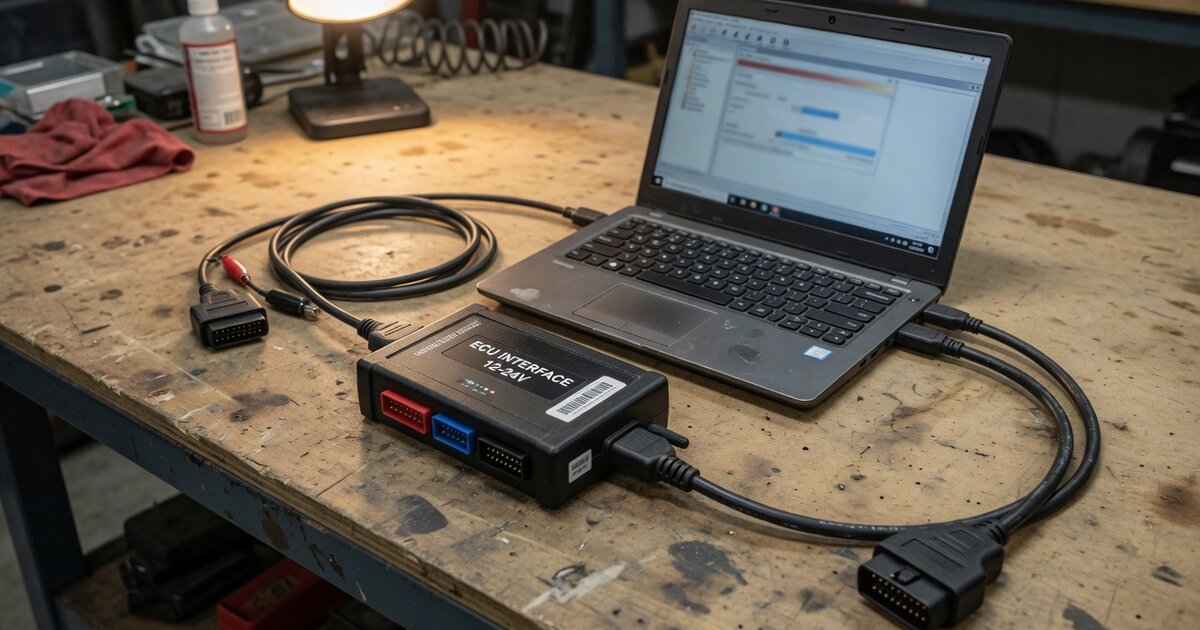
An ECU reprogramming tool is the hardware — and matching software license — a technician uses to write new calibration or firmware data into a vehicle's engine, transmission, body, or other electronic control units. It's a different piece of the workbench than a code reader or generic scanner: a scan tool talks to the module to read data and trouble codes, while a reprogramming tool talks to the module to change what's actually running on it. If you're still deciding whether you need a scanner or a programmer in the first place, our guide to the diagnostic scan tool covers that distinction in more detail, and our ECU coding explained article walks through what coding and programming actually accomplish. This piece stays on the equipment side: the categories of tools shops and technicians actually buy, what separates them, and what to check before spending money on one.
Types of ECU reprogramming tools
OEM dealer-level tools
Every major automaker publishes its own factory programming application — Techstream for Toyota, ISTA for BMW, Xentry for Mercedes-Benz, and similar platforms for other brands. These run on a manufacturer-approved laptop or VCI (vehicle communication interface) and connect to the automaker's own servers to pull the exact calibration file for a given VIN. They give the deepest, most current coverage for that one brand, including security-gated procedures dealers use for immobilizer and module replacement work, but they typically require a paid subscription per brand and don't cross over to other makes.
J2534 pass-thru devices
A J2534 pass-thru device is a standardized interface, defined by SAE, that sits between a PC running the OEM's own reprogramming software and the vehicle's OBD-II port. US EPA rules have required automakers to support J2534 reprogramming for powertrain modules on model-year 2004 and newer vehicles, and most manufacturers have since extended pass-thru access to body, transmission, ABS, and other modules. In practice this means an independent shop can buy one certified J2534 box, install several manufacturers' free or subscription-based software, and reflash factory-original files without owning a full dealer scan tool for every brand — though each OEM's software still has to be licensed and updated separately.
Aftermarket universal programmers
Multi-brand programmers built by aftermarket toolmakers bundle their own vehicle coverage database instead of relying on OEM applications. They're aimed at general repair, ECU swap/clone work, and tuning across a wide spread of makes from one box, and many support OBD, bench, and boot-mode connections in a single unit. Coverage and protocol support vary a lot between models and are usually tied to a subscription, so the same brand's entry-level and professional versions can differ significantly in what modules and vehicles they'll actually write to.
Bench and boot-mode programmers
Bench programming means removing the ECU from the car and wiring it directly to the tool on a bench, bypassing the vehicle harness; boot mode goes a step further, forcing the processor into a low-level bootloader state — sometimes through direct chip access — to read or write memory when normal communication isn't possible. These methods are used for cloning a replacement module, recovering a unit that's already unresponsive over OBD, or working on a module that was never designed to be reflashed through the OBD port at all. They demand more technical skill and carry a higher risk of permanent damage than OBD-based reprogramming, so they're mostly a specialist or recovery-service tool rather than a general-shop first choice.
What to consider before buying
Vehicle and module coverage matters more than the brand name on the tool. Ask specifically which makes, model years, and module types (engine, transmission, body, ABS, ADAS) the coverage list includes, and whether that coverage is a one-time purchase or a recurring subscription — most OEM and many aftermarket tools rebill annually to keep vehicle databases current.
Protocol and connection support is the second filter. Confirm the tool actually supports J2534 pass-thru if you plan to run OEM software through it, and check whether it offers bench and boot-mode connections if you expect to handle dead or removed modules, not just live in-vehicle work.
Legality and warranty exposure need to be checked before, not after, a purchase. Altering emissions-related calibrations is restricted or outright illegal in many jurisdictions, and most automakers void the remaining powertrain warranty on a vehicle once its ECU has been modified outside factory channels — that's a conversation to have with the vehicle owner, not just a technical decision.
Finally, weigh security-gated procedures. Some programming operations — replacing an immobilizer module, programming a new ECU to a chassis — require manufacturer authentication, subscription-based token systems, or VIN-locked sessions that a generic tool simply cannot complete regardless of its protocol support.
Common mistakes to avoid
Letting battery voltage sag during a flash is the single most common cause of a bricked module. A drop in voltage mid-write can corrupt the file being transferred and leave the ECU unable to boot; a battery maintainer holding a stable charge, not just a healthy-looking battery, should be connected for every reprogramming session.
Writing the wrong calibration file is the second major risk. Files are matched to a specific ECU part number, hardware revision, and sometimes VIN — pulling a similar-looking file for the wrong variant can corrupt the module rather than simply fail to install.
Interrupting the session is the third. A loose OBD cable, a laptop that goes to sleep, a dropped Wi-Fi connection on a wireless VCI, or a phone call that pulls attention away from a process that needed monitoring can all abort a write partway through. Reprogramming should be treated as an uninterruptible procedure, not a background task.
Skipping the pre-check is the fourth. Confirming existing fault codes, connector condition, and that the correct base automotive scan tool data has been captured before starting gives a technician something to compare against if the reprogram doesn't go as expected, and can catch a wiring or connection problem before it turns into a bricked module instead of after.
Frequently asked questions
What's the difference between an ECU reprogramming tool and a diagnostic scan tool?
A scan tool reads data streams and trouble codes from a module without changing anything on it. A reprogramming tool writes new calibration or firmware data to the module, which is a more invasive operation with real risk if it's interrupted or done with the wrong file.
Do I need a separate tool for every vehicle brand?
Not necessarily. A certified J2534 pass-thru device paired with each manufacturer's own software can cover reprogramming for many brands from one box, though you still license and update each OEM's software separately. Dealer-level tools like Techstream or ISTA remain brand-specific, and aftermarket universal programmers use their own bundled coverage instead of OEM applications.
Can ECU reprogramming void a vehicle's warranty?
Yes, in most cases. Automakers commonly void the remaining powertrain warranty once an ECU has been reprogrammed outside their own authorized channels, so this should be confirmed with the vehicle owner and, where relevant, the dealer before any non-factory reflash.
Is it legal to reprogram an ECU?
Reprogramming itself isn't universally illegal, but altering emissions-related calibrations is restricted or banned in many jurisdictions, and rules vary significantly by region. It's worth checking local regulations before performing or offering any non-OEM tune.
What causes a bricked ECU during reprogramming?
The most common causes are a battery voltage drop mid-write, an interrupted connection (loose cable, dropped wireless link, sleeping laptop), or writing an incorrect or corrupted calibration file. A stable power supply and confirming the exact correct file for that module are the two biggest safeguards.
When would a shop need bench or boot-mode programming instead of OBD?
Bench and boot-mode access are used when a module can't be reached through the OBD port at all — for example, cloning data to a replacement ECU before it's installed, or recovering a unit that's already unresponsive after a failed flash. They require removing the module and connecting to it directly, which takes more skill and carries higher risk than standard OBD-based reprogramming.