EcuDiag: What This ECU and Airbag Repair Specialist Actually Sells
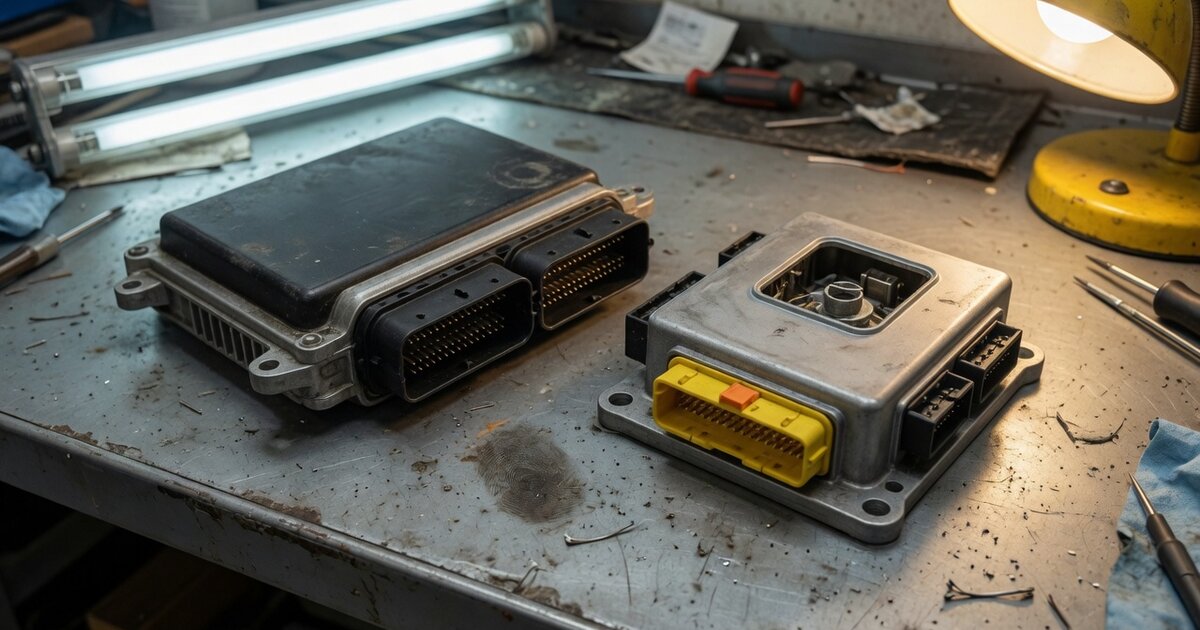
Type "EcuDiag" into a search bar and you will not find a generic diagnostic scanner or a category of software - you will find a real company. EcuDiag is the trading name of a Spain-based specialist that sells ECU, airbag, instrument-cluster, and immobilizer repair equipment through its online store, ecudiag.es, while also operating as an actual repair workshop for those same modules. It is a small-volume, mostly navigational search term: shops and technicians who already know the name search for it directly rather than discovering it through generic "ECU repair tool" queries. That is worth stating plainly up front, because the name sometimes gets lumped in with diagnostic-scanner brands, and it is not one. This article covers what EcuDiag's catalog and services actually consist of, what to check before ordering from it, and where it fits next to more familiar OBD-based programming tools.
What EcuDiag Is and What It Does
EcuDiag operates out of Peligros, near Granada, Spain, and runs an e-commerce catalog (available in Spanish and English, priced in euros) alongside in-house repair services for automotive control units. The business sits at the intersection of two activities usually offered separately elsewhere: it sells the parts and tools that workshops use to repair ECUs themselves, and it repairs units directly for customers who would rather send the part in.
The catalog is organized around the module families that make up the bulk of aftermarket ECU repair work: engine ECUs, airbag control units, immobilizer systems, body control modules (BSI/UCH), instrument clusters, ABS/ESP brake ECUs, gearbox ECUs, steering-wheel reels and sensors, and radio/navigation units. Underneath those categories sit the actual repair components - EEPROM and flash memory chips, integrated circuits, connectors, PCBs, relays, cluster needles, glass, and displays - the kind of small parts a bench technician needs to fix a board rather than replace it outright.
A distinct product line is immobilizer emulators: small hardware modules built for specific IMMO systems (BMW EWS2, Nissan NATS5, Renault/Dacia K-line, Fiat/Alfa/Lancia K-line, Hyundai/Kia Smartra, and a multi-brand "Unican" unit covering several CAN-based systems, among others). These are sold under the ECUSERWIS brand that EcuDiag distributes, and every listing carries the same disclaimer: professional users only, sold without technical support and without connection diagrams. In other words, buyers are expected to already know the wiring and the procedure - the emulator is a component, not a turnkey kit.
The other major equipment line is the I/O Terminal bench interface: a hardware unit that connects to an ECU's board directly, rather than through the OBD port, to read and write memory, sold with separate per-manufacturer software licenses - Bosch, Siemens, and PSA BSI licenses are listed individually, each unlocking read/write support for that ECU family. Service-wise, EcuDiag advertises reprogramming and tuning, ECU repair, control-unit cloning, airbag module resetting, immobilizer deletion, instrument-cluster repair, and board-level soldering - the standard menu for a European auto-electronics workshop that works on modules end to end rather than just plugging in a scan tool.
What to Consider Before Buying or Using It
Because EcuDiag sells to professionals rather than end consumers, the first thing to weigh is whether the item you need actually matches the job in front of you. Immobilizer emulators in particular are protocol- and system-specific: a K-line unit built for Renault/Dacia will not work on a CAN-based system from a different maker, and ordering the wrong variant for your ECU family wastes both the part and the time spent installing it. Since listings explicitly state that no wiring schemes are included, the pinout and procedure need to be sorted before the part arrives, not after.
Shipping originates from Spain, and EcuDiag operates as an EU-based, EUR-priced store, so buyers outside the EU should expect customs duties and VAT handling on top of the listed price, plus delivery times that reflect an international parcel rather than a domestic order. Stock also varies by SKU - some items on the site are marked out of stock while closely related variants remain available, so it is worth checking availability on the exact reference number rather than assuming the whole product family is in stock.
It also helps to place EcuDiag correctly relative to the OBD-based tools most locksmiths and key programmers already own. Bench-level work with emulators and an I/O Terminal-style interface is a different discipline from flashing an ECU through the diagnostic port with something like an MPPS V21 ECU programming tool or a Galletto 1260 OBDII EOBD flashing cable - those tools talk to the ECU in-circuit through K-line or CAN without opening the unit, while EcuDiag's emulators and repair components are for jobs where the unit itself is damaged, needs cloning, or the immobilizer has to be bridged at the board level. If the work at hand is mostly straightforward file read/write and tuning rather than physical module repair, it is worth comparing that broader landscape of piggyback, flash, and standalone ECU tuning tools before committing to bench-repair equipment that may not be needed yet.
Common Mistakes to Avoid
The most common mixup is treating EcuDiag as a diagnostic-scanner brand in the Autel, Launch, or Xtool sense. It is not: there is no proprietary scan-tool app or vehicle-coverage list to check, because the business is a parts and repair-service supplier rather than a multi-brand diagnostic platform. Searching for "EcuDiag compatibility" the way one would search for scanner vehicle coverage will not turn up anything useful.
A second mistake is ordering an emulator or IMMO component without first confirming the exact ECU part number and immobilizer generation fitted to the vehicle. These emulators are built for narrow, named systems - EWS2, NATS5, Smartra2, and so on - and a listing that looks close enough by brand name is not the same as one that matches the actual immobilizer generation on that ECU.
Third, do not assume support is included. The repeated "not support and not connection schemes" notice on professional-grade listings means EcuDiag is selling the hardware itself, not a guided installation. If the procedure is not already familiar, it has to be sourced separately - from prior experience, a training resource, or a paid schematic - before ordering.
Finally, do not skip the ECU-side preparation some emulators require. Several listings specify that the ECU must be "virginized" so it auto-learns the emulator, and skipping that step is a common reason an otherwise-correct emulator appears not to work. Treat every listing's stated requirements and warnings as part of the specification, not boilerplate to skim past.
Frequently Asked Questions
What does "EcuDiag" actually refer to?
It is the trading name of a Spanish company (ecudiag.es, based in Peligros, Granada) that sells ECU, airbag, immobilizer, and instrument-cluster repair parts, emulators, and bench tools, and also performs module repair services directly. It is not a generic industry term or a diagnostic-scanner brand.
Is EcuDiag a scan tool like Autel or Launch?
No. EcuDiag does not make or sell a diagnostic scan tool with a vehicle-coverage database. Its business is repair parts, IMMO emulators, bench interfaces, and repair services for damaged or locked control units - a different category from handheld diagnostic scanners.
Does EcuDiag ship outside Spain?
The store runs an English-language version alongside the Spanish one and prices everything in euros, which indicates it sells beyond Spain. Buyers outside the EU should still confirm shipping cost, delivery time, and import duties or VAT handling before ordering, since these are not standardized across destinations.
Do EcuDiag's immobilizer emulators come with instructions?
Product listings for professional-grade emulators explicitly state they are sold without technical support and without connection schemes. Buyers are expected to already have the wiring and procedure, or to source that documentation separately.
What is the difference between an EcuDiag emulator and a tool like MPPS V21 or Galletto 1260?
MPPS V21 and the Galletto 1260 flash and read/write ECUs through the OBD port using K-line or CAN protocols, without opening the unit. EcuDiag's emulators are physical hardware modules wired or soldered into a system that has to be bridged, cloned, or repaired at board level - a bench job rather than an in-circuit flash.
Who is EcuDiag's catalog aimed at?
Professional auto-electronics technicians and locksmith or key-programming workshops that repair ECUs, airbag modules, and instrument clusters in-house, rather than DIY users or general vehicle owners - most listings say so directly.