How to Choose the Best ECU Reader for the Job
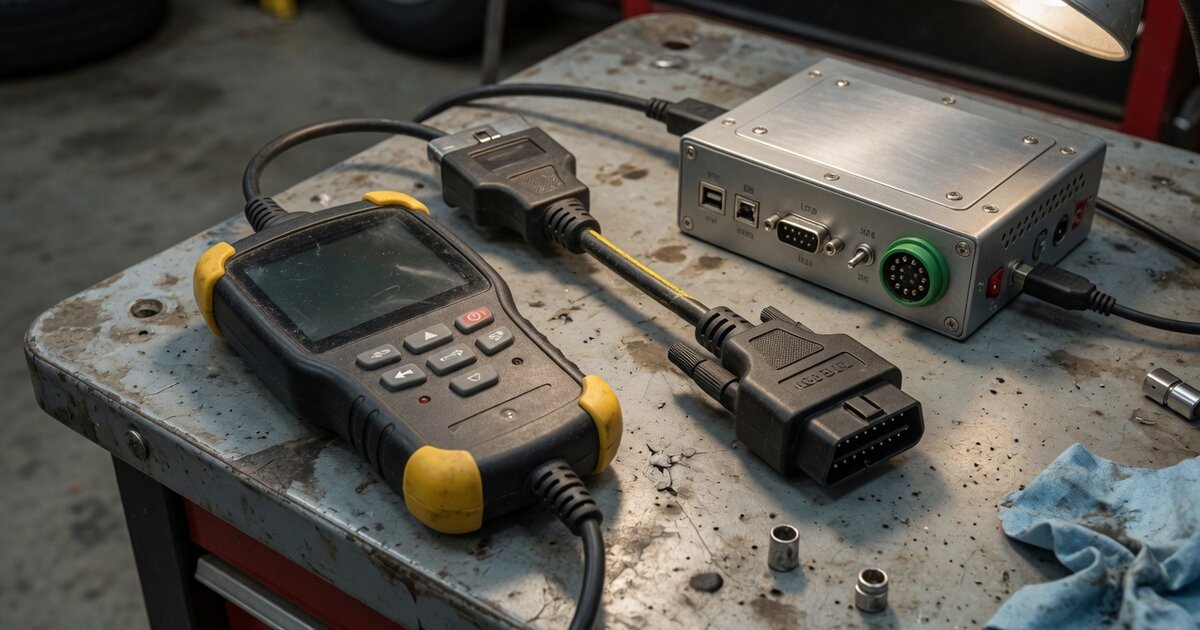
"Best ECU reader" is a search that assumes a single winner exists, but the tools under that label aren't one product category — they're several, built for different access points and different levels of ECU lockdown. A cable that reads a ten-year-old diesel ECU over the OBD port has little in common with a bench station that pulls a locked, modern ECU off the car and talks directly to its processor. Before comparing products, it helps to know what separates a reliable ECU reader from a frustrating one, and which category matches the job: diagnosing a fault, backing up a calibration before a tune, or recovering a bricked module.
What makes an ECU reader good
A good ECU reader is judged on a handful of practical things, not marketing claims.
Documented ECU coverage. The tool should list, by part number or ECU family, exactly which modules it supports for read and write — not a vague "supports most ECUs" claim. Coverage naming specific Bosch, Continental, Denso, Marelli, or Siemens part numbers is far more trustworthy than a blanket promise, because reprogramming support depends on the exact microcontroller and flash memory inside a given ECU, not the vehicle model.
Reliable checksum and file handling. Writing a modified or backed-up file to an ECU without correct checksum calculation is one of the most common ways a working module turns into scrap. A capable tool validates checksums automatically, keeps an unmodified backup of the original file before any write, and warns rather than silently proceeds when something looks wrong.
Genuine, well-built hardware. Interface cables built around commodity USB-to-serial chips are only as reliable as the chip inside them, and this market has a long history of counterfeit components causing intermittent failures — the FTDI chip issues that have dogged cheap clones are a well-documented example, and it's worth understanding how the Galletto 1260 OBDII EOBD ECU flashing cable actually works before assuming a low-cost clone behaves the same way.
Active software support. Vehicle software libraries expand constantly as new ECUs reach the market, so a tool whose software hasn't been updated in years falls behind quickly. A vendor selling an ongoing update or token subscription needs to be judged on total cost of staying current, not just the up-front price.
Speed appropriate to the interface. K-line is inherently slower than CAN, and CAN is slower than a direct bench connection. That's physics, not a defect — judge a tool against others using the same connection method, not against an unrelated bench station.
Matching the tool to the job
There's no single "best" ECU reader because the category splits into tools built for different points of access, and picking the wrong one wastes money without solving the actual problem.
Basic OBD2 scanners are diagnostic-only: they read trouble codes, live sensor data, and freeze frames through the standardized 16-pin connector, but they aren't built to rewrite ECU calibration at all. If the goal is figuring out what's wrong with a car rather than editing how it runs, it's worth understanding what an OBD2 reader actually does and where its limits are before buying a reprogramming tool that solves a different problem.
OBD-based flashing cables sit a step up: they use the same physical port but talk to the ECU's bootloader over K-line or CAN to read and write calibration already accessible from outside the car. These work well on older, pre-CAN and early-CAN ECUs, but generally can't reach modules locked down with newer security algorithms, and can't recover an ECU that no longer responds at all.
Bench and boot programmers go further: the ECU is removed and connected via a bench harness, and the tool talks directly to the processor or flash memory — sometimes forcing the microcontroller into a boot mode that bypasses the application software's security checks. This category recovers bricked ECUs, reads modules that reject OBD access, and handles newer, better-protected units a flashing cable can't touch. It demands more skill and money, but it's the only option once an ECU is locked, corrupted, or too new for OBD-level access.
Brand-specific and dealer-level tools trade breadth for depth: they cover one manufacturer's ECUs unusually well, at the cost of being useless outside that brand. For a shop working across many makes, a generalist bench tool with wide part-number coverage is usually more practical than a stack of single-brand boxes.
It's also worth separating reading tools from tuning tools. A reader's job is to get an accurate copy of the calibration off the ECU and write a modified one back; what goes into that modified file — piggyback signal interception, direct flash editing, or a full standalone replacement — is a separate decision, covered in the breakdown of piggyback, flash, and standalone ECU tuning options.
Common mistakes to avoid
Buying an OBD cable and expecting bench-tool results. The most common disappointment is buying an inexpensive K-line or CAN flashing cable and finding it can't touch a locked or bricked ECU — that was never within its design scope.
Skipping the backup. Every write should start with a saved, verified copy of the original file. Skipping this turns a routine tune or repair into a potential total loss of the ECU if the write fails partway through.
Trusting a clone without checking who's behind it. Cheap hardware clones flood this market and quality varies between sellers even when listings look identical. Check feedback, ask about the chipset used, and confirm the software runs on your operating system before buying.
Ignoring exact part-number compatibility. "Fits most cars 2005 and up" isn't the same as confirmed support for the specific ECU part number on the vehicle in front of you. Two vehicles with the same engine can carry different ECU hardware depending on market or trim.
Forgetting ongoing costs. Some tools require annual subscriptions or per-file tokens to keep working. Factor that into total cost of ownership, not just the price on the box.
Assuming one tool covers everything. A shop handling both routine diagnostics and locked or bricked ECUs typically needs more than one tool — an OBD-level solution for accessible work and a bench/boot solution for the rest.
Frequently asked questions
What's the difference between an ECU reader and an OBD2 scanner?
A standard OBD2 scanner reads diagnostic trouble codes and live sensor data but can't rewrite the ECU's calibration file. An ECU reader is built specifically to extract and, usually, rewrite that calibration data, either through the OBD port on ECUs that allow it or through a direct bench connection on ones that don't.
Can I read an ECU without removing it from the car?
Sometimes. Many older ECUs with K-line or accessible CAN flashing routines can be read and written entirely through the OBD port while still installed. Newer or more heavily protected ECUs, and any that no longer communicate at all, typically require removal and a bench or boot-mode connection.
Why do some ECU readers need bench or boot mode?
Manufacturers add security layers that block flashing over the OBD port once an ECU is fully locked, and a bricked or unresponsive ECU can't be reached through its normal protocol at all. Bench and boot-mode access work around both problems by talking directly to the processor or memory chip, forcing it into a state where the tool can read and write regardless of what the application software is doing.
Are cheap clone ECU tools worth buying?
It depends on the specific tool and seller, not the category as a whole. Clone hardware has a documented history of counterfeit chips causing intermittent failures, so a low price is only a good deal if the seller's build quality and support are actually reliable — worth checking before purchase, not after a failed write.
Does an ECU reader let me tune the car myself?
An ECU reader gets you an accurate copy of the calibration file and lets you write a new one back — it doesn't create the tuned file for you. Modifying the maps inside that file safely requires separate tuning software or a calibrator's expertise; the reader is only the delivery mechanism between file and car.
How do I know if a tool supports my specific ECU?
Check the vendor's published coverage list against the exact ECU part number stamped on the unit in the car, not just the vehicle's make, model, and year. Forums for the specific tool are usually the fastest way to confirm real-world support, since official lists can lag behind what the software actually handles.