What Is Key Coding? Mechanical Bitting vs. Electronic Programming Explained
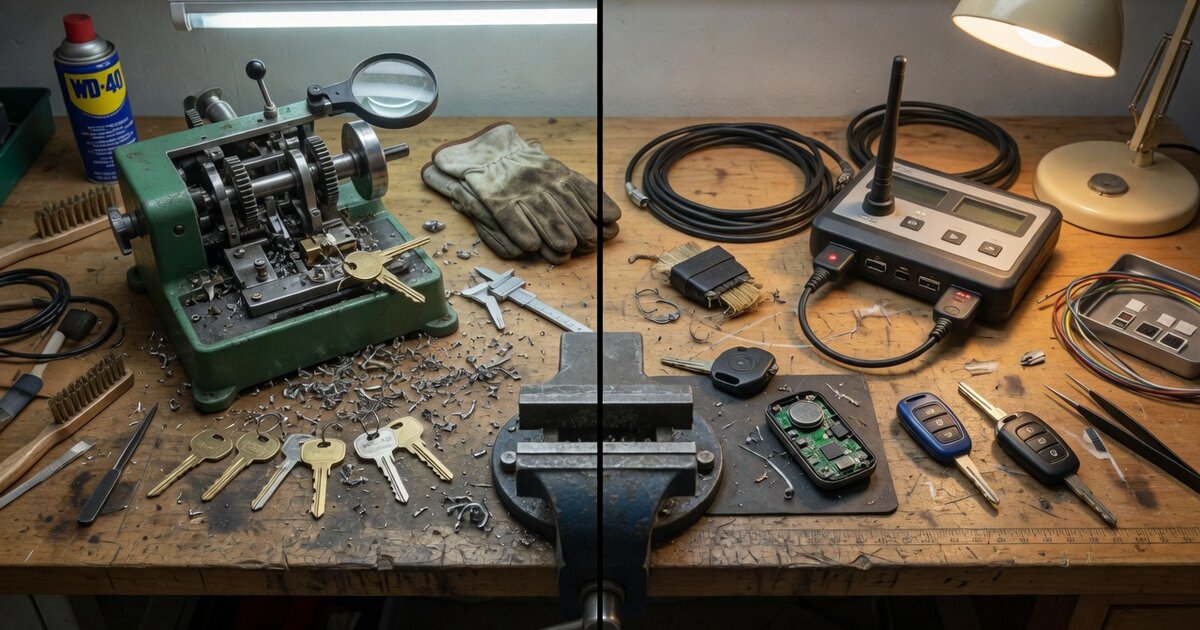
Search for "key coding" and you land in the middle of a term automotive locksmiths use loosely and car owners often misread. It sounds like it should mean one thing, but in the trade it covers two separate jobs that happen to share a name. One is mechanical: figuring out the exact pattern of cuts a key blade needs when there's no original key to copy from. The other is electronic: getting a transponder chip, remote, or replacement module to "talk" correctly to the car's immobilizer so the engine will actually start. Knowing which one a customer, a supplier, or a forum post actually means saves wasted time and the wrong tool purchase.
The two meanings of key coding
The older, more literal sense of key coding is about bitting. A key code is a short string of letters and numbers — something like a General Motors "23N7" or a Nissan "X2100" — that a manufacturer assigns to a specific cut pattern. On its own, that code doesn't tell you where to cut anything; it's a reference, not an instruction. Locksmiths convert it into an actual bitting (the sequence of cut depths and spacing along the blade) using key code software or charts, then cut a blank to match. This is what lets a locksmith produce a working mechanical key with no original present, working from a code tied to the VIN, a code stamped on the door lock, or a code decoded directly from the cylinder with a pick-and-decode tool.
The newer sense — the one most people actually mean when they search the term — is electronic. Since the mid-1990s, nearly every car sold has shipped with an immobilizer that checks for a matching transponder chip or rolling code before letting the engine start. "Coding" a key in this sense means writing the vehicle-specific data into a new key's chip, or writing the vehicle's data into a replacement immobilizer or control module so it accepts a key that wasn't part of the original set. This is what most people mean by "key programming," and on many newer vehicles the two senses are inseparable, because a lost-key job usually needs both: a correctly cut blade to turn the lock, and a correctly coded chip to satisfy the immobilizer.
How it works in practice
On an all-keys-lost job, mechanical coding usually comes first. With no working key and no code on hand, a locksmith has three realistic options: pull a factory code from a VIN through an authorized data source, when the manufacturer makes that data available; read a code physically stamped somewhere on the vehicle, since some door locks still carry one; or decode the lock cylinder directly with a keyway-specific pick-and-decode tool such as a Lishi, reading the pin or wafer depths as the lock is picked open. Whichever route is used, the result is a bitting the locksmith cuts into a blank on a code-capable machine, without ever having seen an original key. Choosing that machine is its own decision — keyway coverage, code database support, and blade compatibility vary a lot between models, which is worth checking against a proper buyer's guide to key making machines before committing to one.
Electronic coding is a separate step that usually follows, or runs in parallel on smart-key systems with no cut blade at all. The technician connects a diagnostic or key programming tool to the OBD-II port, authenticates with the immobilizer — sometimes with a PIN pulled from the VIN lookup, sometimes through a security-gateway bypass — and writes the new key's identifier into the module's memory. On higher-security platforms that isn't possible through OBD-II alone, and the technician has to read and write the immobilizer or ECU's EEPROM directly, which is riskier work reserved for trained technicians. Some equipment now spans both sides of the trade: modern key-cutting platforms increasingly bundle code readers and non-contact bitting scanning into the same unit, part of what a listing is actually selling when it advertises something like Xhorse 3D scanning on a key-cutting machine rather than a traditional tracer-and-cutter setup.
Common mistakes to avoid
The most common mistake is treating "key coding" and "key cutting" as interchangeable, then being surprised when a freshly cut key won't start the car. A cut key only handles the mechanical side — turning the door lock or ignition cylinder. If the vehicle has an immobilizer, which almost every car built since the late 1990s does, the engine won't start until the chip is coded to that specific vehicle, however precisely the blade was cut. The reverse mistake happens too: assuming a key that starts the car must have been "coded," when a working spare was simply cloned from an original without touching the bitting-code side at all.
Another frequent error is relying on a blind code without converting it correctly — a blind code by itself is not a bitting, and running it through the wrong series or a stale database produces a key that looks right but won't turn the lock. People also underestimate how manufacturer-dependent VIN-based code retrieval is: availability depends on the manufacturer's own policy and what data was captured when the vehicle was built, so a guaranteed VIN lookup promised without checking first sets expectations the data may not support.
On the electronic side, people sometimes assume "coding" will fix a fob that's stopped communicating for a physical reason rather than a data one — corrosion on the battery contacts or a fried circuit board after water exposure won't be solved by recoding and needs the fob itself repaired first. If that's the situation, it's worth checking what actually helps when a car key fob gets wet or goes through the wash before assuming a reprogram will bring it back.
Frequently asked questions
Is key coding the same thing as key programming?
In the electronic sense, yes — the terms are generally used interchangeably for writing a transponder or remote's identifier into a vehicle's immobilizer system. Where they diverge is the older mechanical sense of key coding, which is about converting a manufacturer code into a physical cut pattern and has nothing to do with programming electronics.
Can a key be coded without the original key present?
Yes, in both senses. Mechanically, a locksmith can derive the correct bitting from a VIN-based lookup, a code stamped on the vehicle, or a code read directly from the lock cylinder with a decoding tool, then cut a blank to match without ever seeing the original. Electronically, most modern programming tools support all-keys-lost procedures that add a new key to the immobilizer even when every existing key has been lost, though the method and difficulty vary sharply by manufacturer and model year.
Do I need a locksmith, or can I code a key myself?
It depends on the vehicle and what needs coding. Some manufacturers support simple in-car procedures an owner can follow with an existing working key to add a spare. Others require dealer-level or aftermarket diagnostic tools, security PIN retrieval, or EEPROM-level work that isn't realistic without professional equipment and training — there's no single answer that covers every make.
Why does a VIN-based key code sometimes come back unavailable?
VIN-to-code lookups depend on data the manufacturer chose to make available to authorized locksmith networks, and that availability differs by brand, region, and how the vehicle's records were handled over its life. A VIN that returns nothing from one source doesn't necessarily mean no code exists — it may just mean that source doesn't have it, which is why locksmiths sometimes fall back on stamped codes or on-vehicle decoding instead.
What's the difference between a blind code and a bitting code?
A bitting code describes the actual cuts on the key directly. A blind code is a reference number that has to be translated into a bitting through a chart or key code software before it means anything to a cutting machine — on its own it gives no clue about the cut depths until it's converted.
If a key won't start the car after cutting, is the problem the coding?
Usually, yes — if the mechanical fit is confirmed correct and the key turns the lock cleanly but the engine doesn't start, the remaining variable is almost always electronic: the transponder or fob hasn't been coded to that vehicle's immobilizer yet, or was coded incorrectly. If the key doesn't turn the lock at all, the problem is mechanical — the bitting itself is wrong and needs to be re-derived rather than the electronics re-coded.