VIN Decoder: What It Reveals for Key Codes and Replacement Fobs
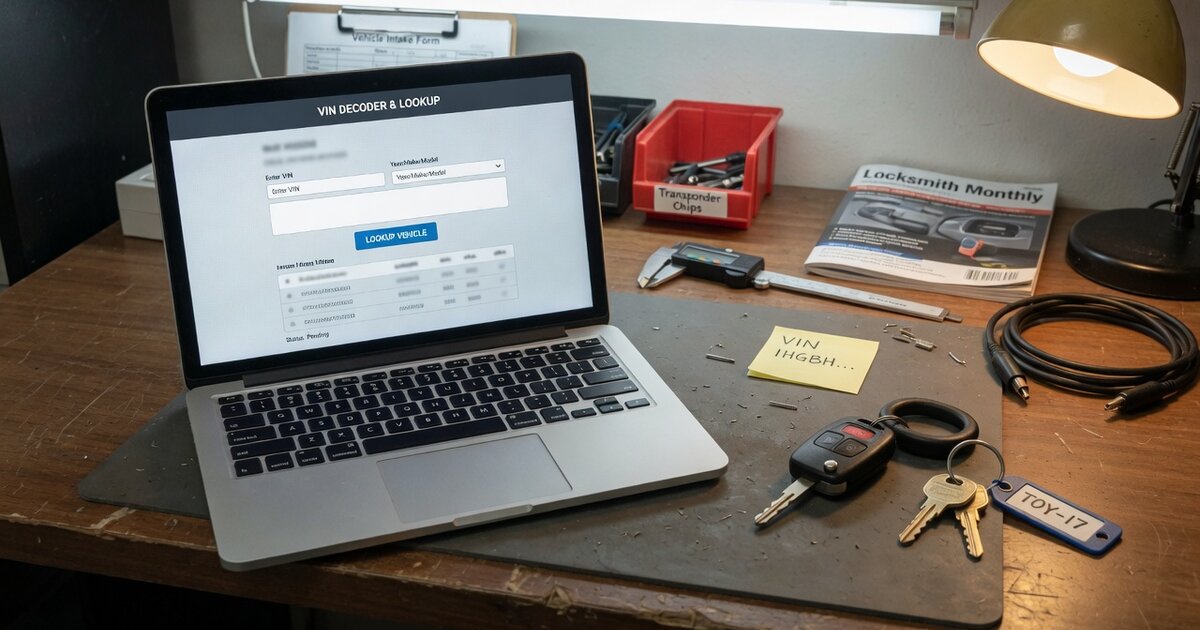
Type a VIN into a free online tool and you'll get back a trim level, an engine size, maybe a factory paint code. That's the version of a VIN decoder most drivers know. In the key-programming world, though, that same 17-character string is doing heavier lifting: it's the difference between a locksmith cutting the right key on the first visit and a customer paying for a fob that never talks to their car. If you're trying to get a replacement key made, understanding what a VIN decoder actually pulls out of that number — and why a "close enough" match isn't good enough — will save you a wasted trip.
What a VIN decoder actually does
A Vehicle Identification Number is a fixed 17-character code, standardized internationally under ISO 3779 and ISO 4030, and it isn't random. It's built from three blocks. The first three characters are the World Manufacturer Identifier (WMI), which pin down the country of origin and the manufacturer. Characters four through eight make up the Vehicle Descriptor Section (VDS), which encodes body style, engine, and platform according to each automaker's own internal scheme — this part isn't standardized between manufacturers, which is why a decoder needs manufacturer-specific reference tables, not just character math. Character nine is a check digit used in North America to validate that the VIN wasn't mistyped. The last eight characters form the Vehicle Identifier Section (VIS): character ten is the model year, character eleven is the assembly plant, and the final six digits are the vehicle's unique sequential production number.
A VIN decoder parses those positions and cross-references them against manufacturer build data to return human-readable output — trim, drivetrain, factory options, sometimes original equipment. In the US, NHTSA runs a free public decoder (vPIC) that covers the standardized portions of the VIN reliably; anything tied to a specific automaker's option codes depends on how complete that manufacturer's data is, which is why two different decoders can return slightly different answers for the same VIN.
Why VIN matters for key programming specifically
For a locksmith or dealer, decoding a VIN isn't about trivia — it feeds three decisions that directly affect whether the key they cut or program actually works.
The first is pulling a factory key code. On many older vehicles, the ignition and door locks were cut to a code tied to the VIN, retrievable and usable to cut a working key without ever touching the original. That's not a free lookup, though: because a key code is effectively a security credential, access to it in the US runs through OEM-authorized channels coordinated by the National Automotive Service Task Force (NASTF), whose Vehicle Security Professional registry has credentialed locksmiths and technicians for this exact purpose since 2008 under what NASTF calls its Secure Data Release Model. Newer vehicles increasingly skip a simple cuttable code altogether — many now require in-person ownership verification and a security PIN through that same gated OEM process, part of why the line over who can reprogram a car key has gotten stricter, not looser.
The second is confirming which immobilizer or security-system generation the car actually has. Automakers don't hold one transponder architecture constant across an entire model's run — a mid-cycle refresh, a supplier change, or an encryption upgrade partway through production can put two cars with the same nameplate and model year on different systems. The VIN's model-year character and plant/serial digits let a technician pin down exactly which generation is under the dash before selecting a chip, protocol, or programming procedure — which matters because, as covered in the breakdown of mechanical bitting versus electronic programming, cutting the correct blade shape is only half the job if the transponder side doesn't match.
The third is ordering the correct replacement fob. It's common for one model and model year to have shipped with more than one FCC ID or part number for its key fob — different trims, different markets, or a running mid-year supplier change can all produce variants that look identical but aren't interchangeable. Decoding the VIN narrows the field of candidates considerably, but because aftermarket decoder databases are aggregated from public and manufacturer data rather than guaranteed by the automaker, the safest workflow still cross-checks the decoder's output against the vehicle's actual glovebox or door-jamb parts sticker, or a dealer parts lookup, before a fob gets ordered.
Common mistakes to avoid
The most common error is treating a free web decoder's fob or FCC ID suggestion as final. These tools are genuinely useful for narrowing options fast, but they're built from aggregated data, not a live feed from the automaker, so a mid-year change or a market-specific variant can slip through. Verify against the physical vehicle before buying or programming anything.
A related mistake is assuming that "same make, model, and year" is specific enough. It isn't — it's exactly why the VIN exists. Two vehicles built four months apart on the same line can carry different immobilizer hardware. Always decode the actual VIN in front of you, not a "representative" one from a forum post or a friend's identical-looking car.
It's also worth being precise about what a VIN decoder is not: it's an information tool, not a bypass tool. Actually retrieving a factory key code or pairing a new key to a car's security system requires verified access through OEM-sanctioned channels — the decoder just tells you what you're working with. And because a single mistyped character can pull an entirely wrong vehicle's data, always confirm the VIN against the title, registration, or dash plate rather than trusting a number copied down by hand. This is also where it helps to know your options going in — a hardware-store key cutter isn't equipped to touch immobilizer programming at all, so understanding where to get car keys copied before you show up saves a wasted stop.
Frequently asked questions
Can a VIN decoder give me my car's actual key code?
No, not a public one. Free VIN decoders return build and options data, not security credentials. Where a factory key code still exists for a given vehicle, retrieving it requires proof of ownership and access through OEM-authorized systems — the kind of credentialed access that NASTF's Vehicle Security Professional program was set up to control, not something a public lookup tool is permitted to hand out.
Does every VIN decoder show the same information?
No. The standardized parts of the VIN — manufacturer, model year, check digit — decode consistently across tools. But anything drawn from a manufacturer's own option codes depends on how complete and current that decoder's underlying data is, which is why two decoders can disagree on trim-level or equipment details for the same VIN.
Why do two cars with the same VIN prefix need different keys?
A shared prefix only confirms manufacturer, general model line, and sometimes plant — it doesn't guarantee identical hardware. Running production changes, trim splits, and regional variants can put different immobilizer systems or fob part numbers on vehicles that otherwise look identical, which is exactly what the rest of the VIN is there to distinguish.
Is a VIN decoder the same as a key programming tool?
No. A decoder is purely informational — it tells you what the vehicle is and what it likely takes. A key programming tool is the hardware and software that actually communicates with the car's immobilizer module to pair a new key or fob. Many programming tools do read the VIN from the vehicle to help select the correct procedure, but that's a separate function from decoding.
What should I check before ordering a replacement fob using VIN lookup?
Confirm the FCC ID printed inside the battery compartment of an existing fob if one is available, or the parts sticker in the glovebox or door jamb, and cross-check that against the decoder's suggestion rather than relying on the decoder alone. This matters most on models known to have shipped multiple fob variants within one model year.
Can I decode a VIN myself before calling a locksmith?
Yes, and it's a reasonable first step — it helps you describe the vehicle accurately and can surface whether it's a model known for multiple key or fob variants. Just don't treat the output as a final answer; a locksmith will still verify against the physical vehicle and, for factory codes or programming, needs credentialed access the decoder itself can't provide.